

 1 day ago
2
1 day ago
2
PROTECT YOUR DNA WITH QUANTUM TECHNOLOGY
Orgo-Life the new way to the future Advertising by AdpathwayPublished June 10, 2026 10:37AM
Yoga Journal’s archives series is a curated collection of articles originally published in past issues beginning in 1975. This article about how to stretch first appeared in the May-June 1996 issue of Yoga Journal.
Regular intelligent stretching—and understanding how to stretch—is as important a component of a total fitness program as strength training and aerobic conditioning. People who include yoga in their daily fitness routine find that the stretches they learn in class help their performance in other sports.
Unfortunately many health-conscious people who don’t practice yoga regularly neglect that part of their regimen, complaining that stretching just hurts too much. This attitude sets up a vicious circle: The less they stretch, the tighter they become; the tighter they become, the less they want to stretch, and so on, until an injury occurs.
Following are a series of very basic but effective stretches for 11 important areas of your body. Whether you are an athlete or just want to incorporate more stretching into your daily routine, these stretches—if you practice them consistently—will increase your flexibility gradually and safely. Although these exercises are suitable for all fitness levels, it is always a good idea to check with your health professional before beginning a new fitness routine.
A word of friendly caution for all the stretches recommended in this article: Hold each stretch for 30 seconds in good alignment and then switch to the other side. You may want to stretch again on both sides but do not overdo it by forcing, bouncing in and out of the pose, or having someone else push you down. Breathe softly and evenly throughout your stretching routine. Practice the complete series at least six times a week for maximum improvement.
11 Stretches to Add to Your Routine
If you don’t have the time to do all 11 stretches in sequence, divide them up to practice at different times throughout your day. the key to gaining flexibility is to keep at it—stretch every day. Gradually it may even feel so good that you will actually crave it. But more important, you will become more adaptable, which is one of the hallmarks of a healthy person.
1. Hamstring Stretch
This effective stretch to loosen the hamstrings that will improve walking, running, and all other activities that use the legs as pivotal propellers. The lower back benefits as well: As the hamstrings loosen they allow the pelvis to move more freely, thus helping to release the lower back.
How to: Begin by finding a sturdy support on which to place your elevated leg. You may want to try using a stairwell so you can hold on to the banister. If you use a chair or sturdy piece of furniture, make sure it will not move and that you have something secure to hold on to.
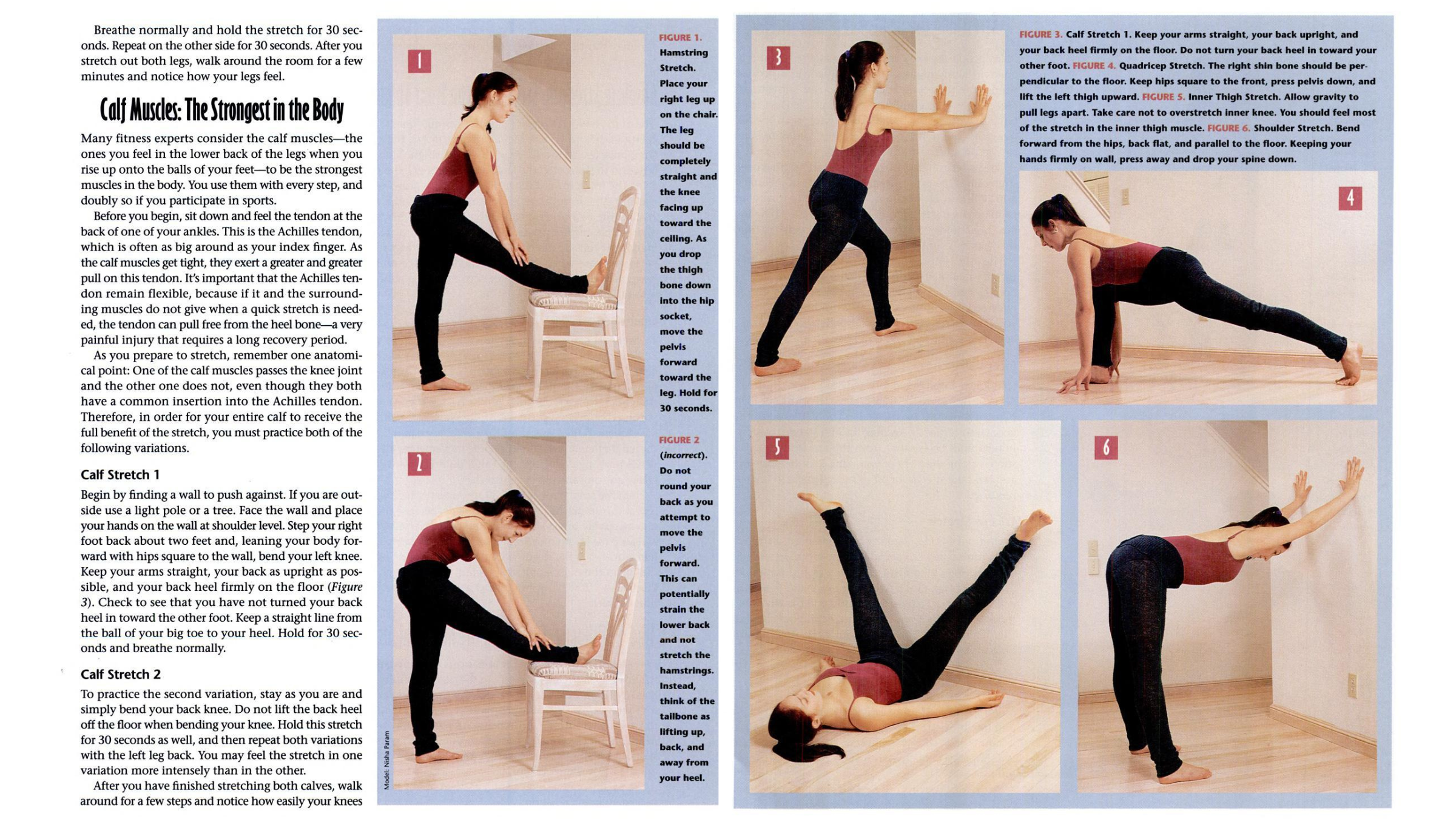
Place your right leg up. Make sure that it is completely straight. If you aren’t able to straighten your leg, lower the support. Rotate your kneecap so it looks straight up at the ceiling. Check your supporting foot; it should point straight ahead and not turn out.
 (Photo: Yoga Journal, 1996)
With both knees straight, picture the thigh bone of the lifted leg dropping down in the hip socket, i.e., toward the floor. At the same time move your pelvis forward toward the leg (Figure 1). To accomplish this action, most people will round out their lower back to produce the movement (Figure 2). Not only does this potentially strain the structures of the lower back, but it doesn’t stretch the hamstrings. To move the pelvis properly, think of the tailbone (coccyx) as lifting up, back, and away from your heel. If you can lift the tailbone in combination with dropping the thigh bone down and keeping the knees straight, you will feel the hamstrings stretching in the back of the thigh.
Breathe normally and hold the stretch for 30 seconds. Repeat on the other side for 30 seconds. After you stretch out both legs, walk around the room for a few minutes and notice how your legs feel.
2. Calf Stretch 1 + 2
You use your calf muscles with every step, and doubly so if you participate in sports. As you prepare to stretch, remember one anatomical point: One of the calf muscles passes the knee joint and the other one does not, even though they both have a common insertion into the Achilles tendon.
How to: Begin by finding a wall to push against. If you are outside use a light pole or a tree. Face the wall and place your hands on the wall at shoulder level. Step your right foot back about two feet and, leaning your body forward with hips square to the wall, bend your left knee.
Keep your arms straight, your back as upright as possible, and your back heel firmly on the floor (Figure 3). Check to see that you have not turned your back heel in toward the other foot. Keep a straight line from the ball of your big toe to your heel. Hold for 30 seconds and breathe normally.
In order for your entire calf to receive the full benefit of the stretch, you must practice both of the following variations.
How to: To practice the second variation, stay as you are and simply bend your back knee. Do not lift the back heel off the floor when bending your knee. Hold this stretch for 30 seconds as well, and then repeat both variations with the left leg back. You may feel the stretch in one variation more intensely than in the other.
After you have finished stretching both calves, walk around for a few steps and notice how easily your knees and ankles move. Because the calf muscles are so strong, you may want to practice these stretches more than once a day.
3. Quadricep Stretch
Quads function to straighten the knee and to a lesser extent bring the thigh toward the trunk. In response to continued and strong demand, the muscle fibers become thicker in order to perform more work. With this increased size and strength in the muscle, however, accompanying tightness often results.
How to: To stretch the quadriceps, get down on the floor in a lunge position with the right leg forward and the knee bent. Make sure that the right shin bone is exactly perpendicular to the floor (Figure 4). Keep the left leg straight and stretch out through the heel as if you are putting that heel on the floor. At the same time, with hips square to the front, press the pelvis down and lift the left thigh upward. These opposite movementsthe pelvis pushing down and the thigh pulling up—will create a strong and effective stretch.
Hold the stretch for at least 30 seconds. It’s good to repeat this stretch again on the same side, because the quadriceps are unusually strong muscles. Reverse legs and keep the breath moving and soft during the stretch. Remember, it is the steady holding without bouncing that gives the muscles fibers sufficient time to let go. Practice this stretch before and after a jog, or at least six times a week.
4. Inner Thigh Stretch
It takes determined effort to stretch out these muscles. First, almost any sport or physical activity you perform will tighten and strengthen the inner thigh muscles. Second, because we often sit in chairs holding the thighs close together for prolonged periods of time, the muscles don’t have a chance to loosen up on a daily basis. This stretch can help.
How to: Sit near a smooth wall with your right shoulder toward the wall. As you roll onto your back, swing your legs up the wall. Make sure you are far enough away from the wall so you can straighten your legs and completely support your lower back. You may want to have a small towel or pillow nearby to place under your head.
Slowly let your legs split apart equally to the sides (Figure 5). It doesn’t matter how far apart the legs are; this distance will increase with time. Allow gravity to pull the legs open; feel the stretch along the inner thigh of each leg. Breathe normally and remain in the pose for 30 seconds to one minute. To come out of the pose, bend your knees, draw them toward your chest, and roll onto your side. Lie there a moment before getting up, using your arms for support.
Take care during the practice of this stretch not to overstretch your inner knee. If you feel most of the stretch at the inner knee and not in the heart of the inner thigh muscles, bring the legs closer together and allow the stretch to be more gradual.
5. Shoulder Stretch
This simple stretch will bring flexibility to the shoulders and relieve any undue hunching. You will need a wall or a desk approximately waist-high or higher. Some people find that a kitchen sink is the perfect place to practice this pose while they wait for the tea kettle to boil.
How to: Face a wall or desk. Place your feet about 18 inches apart with the feet pointing straight ahead. Put your hands at shoulder height on the wall or the sturdy surface of a desk, and begin to walk backward until you are bending forward from the hips and your back is flat and parallel to the floor (Figure 6). Push away from the wall gently with an inhalation, keeping your hands planted on the wall, and drop your spine down with an ex-halation. Without moving your hands, let the back continue to drop down.
If you are stretching at the sink, hook your fingers over the edge of the sink and lean back as you stretch. Drop the spine with each exhalation. Hold the stretch for 30 seconds; then walk slowly forward to stand up. Repeat the stretch noticing, upon standing up, how relaxed your shoulders feel.
6. Biceps Stretch
Many people use exercise machines and free weights to build their arm muscles. This can be beneficial, because strong arms protect the back when you are lifting heavy objects. But the tightness that inevitably ensues from building your arm muscles can interfere with the full range of motion in the shoulder joint, inhibit full and easy respiration, and adversely affect your posture.
 (Photo: Yoga Journal, 1996)
The bicep’s primary actions are to turn your palm up when it is facing down, to bend the elbow and flex the shoulder, and to raise your arm overhead from the front of your body.
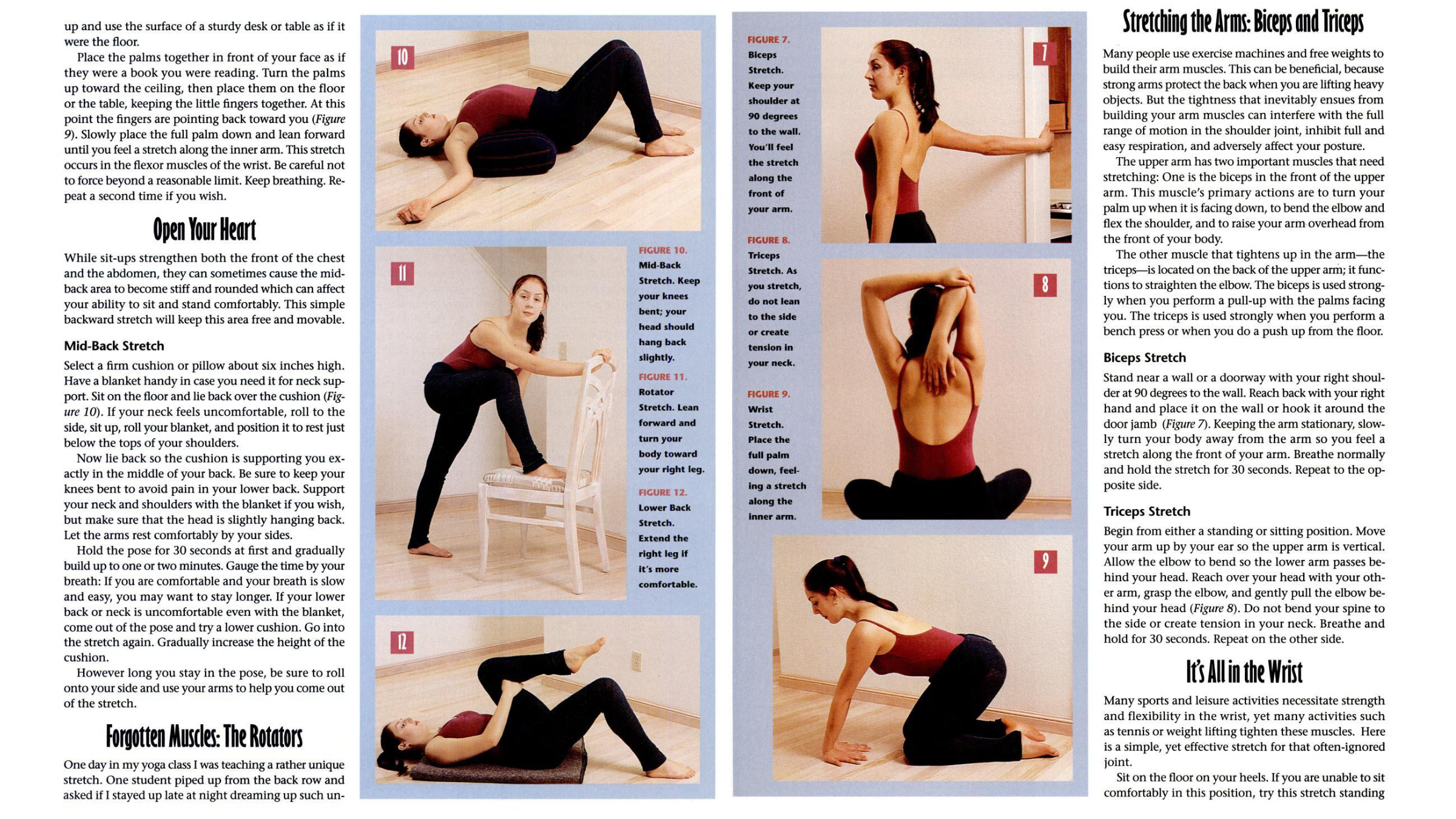
How to: Stand near a wall or a doorway with your right shoulder at 90 degrees to the wall. Reach back with your right hand and place it on the wall or hook it around the door jamb (Figure 7). Keeping the arm stationary, slowly turn your body away from the arm so you feel a stretch along the front of your arm. Breathe normally and hold the stretch for 30 seconds. Repeat to the opposite side.
7. Triceps Stretch
The other muscle that tightens up in the arm-the triceps—is located on the back of the upper arm; it functions to straighten the elbow. The triceps is used strongly when you perform a bench press or when you do a push up from the floor.
How to: Begin from either a standing or sitting position. Move your arm up by your ear so the upper arm is vertical. Allow the elbow to bend so the lower arm passes behind your head. Reach over your head with your other arm, grasp the elbow, and gently pull the elbow behind your head (Figure 8). Do not bend your spine to the side or create tension in your neck. Breathe and hold for 30 seconds. Repeat on the other side.
8. Wrist Stretch
Many sports and leisure activities necessitate strength and flexibility in the wrist, yet many activities such as tennis or weight lifting tighten these muscles. Here is a simple, yet effective stretch for that often-ignored joint.
How to: Sit on the floor on your heels. If you are unable to sit comfortably in this position, try this stretch standing up and use the surface of a sturdy desk or table as if it were the floor.
Place the palms together in front of your face as if they were a book you were reading. Turn the palms up toward the ceiling, then place them on the floor or the table, keeping the little fingers together. At this point the fingers are pointing back toward you (Figure 9). Slowly place the full palm down and lean forward until you feel a stretch along the inner arm. This stretch occurs in the flexor muscles of the wrist. Be careful not to force beyond a reasonable limit. Keep breathing. Repeat a second time if you wish.
9. Mid-Back Stretch
While sit-ups strengthen both the front of the chest and the abdomen, they can sometimes cause the mid-back area to become stiff and rounded which can affect your ability to sit and stand comfortably. This simple backward stretch will keep this area free and movable.
How to: Select a firm cushion or pillow about six inches high. Have a blanket handy in case you need it for neck support. Sit on the floor and lie back over the cushion (Figure 10). If your neck feels uncomfortable, roll to the side, sit up, roll your blanket, and position it to rest just below the tops of your shoulders.
Now lie back so the cushion is supporting you exactly in the middle of your back. Be sure to keep your knees bent to avoid pain in your lower back. Support your neck and shoulders with the blanket if you wish, but make sure that the head is slightly hanging back. Let the arms rest comfortably by your sides.
Hold the pose for 30 seconds at first and gradually build up to one or two minutes. Gauge the time by your breath: If you are comfortable and your breath is slow and easy, you may want to stay longer. If your lower back or neck is uncomfortable even with the blanket, come out of the pose and try a lower cushion. Go into the stretch again. Gradually increase the height of the cushion.
However long you stay in the pose, be sure to roll onto your side and use your arms to help you come out of the stretch.
10. Rotator Stretch
Rotator muscles, located deep in the buttocks, attach to the outer hip and pass almost horizontally toward the sacrum to attach there. As you become more and more fit, and your legs, hips, and buttocks become stronger, these external rotators become tighter and tighter. The rotators in particular are important stabilizers of the pelvis that work strongly whenever you run, kick, or stand on one leg.
How to: Using a sturdy chair, place your right foot up on the seat so your lower leg is firmly placed against the chair back. Make sure that your shin is perpendicular to the floor. Hold the back of the chair with your right hand and bend forward to place your left hand on the seat of the chair (Figure 11). If you want more stretch, lean forward and place your entire forearm on the seat of the chair. To increase the stretch even more, move your left leg backward a little bit without compromising your stability.
Continuing to lean forward, exhale and turn your body toward your right leg to feel the stretch along the outer hip or flank. Continue breathing softly and hold for 30 seconds. Repeat with the left leg. This may feel like one of the deepest stretches of the entire series. After you have finished stretching both sides, walk around a few steps to enjoy the new freedom in your hips.
11. Lower Back Stretch
While lower back pain may have a variety of causes, the following gentle stretch can help. Use this stretch before and after athletic pursuits, in the morning to get you going, or at night to relieve the stress of the day.
How to: Lie on your back on a rug or blanket with your legs extended. Inhale, and as you exhale, release your lower back toward the floor. Then, on the next exhalation, bend your right knee slowly toward your chest. Place both hands between the calf and the thigh in the bend of the knee (Figure 12). Gently pull the thigh toward your chest, holding it for up to 30 seconds as you breathe quietly. Leave your left leg extended on the floor or bend your knee and place the left foot on the floor—whichever is more comfortable. Slowly straighten the right leg, and then repeat the stretch on the left side.
When you have finished stretching both sides, lie quietly for a few minutes on your back with both knees bent and your feet on the floor. Breathe slowly and easily and enjoy the restful moment at the end of your stretching routine.








 English (US) ·
  French (CA) ·