

 19 hours ago
1
19 hours ago
1
PROTECT YOUR DNA WITH QUANTUM TECHNOLOGY
Orgo-Life the new way to the future Advertising by Adpathway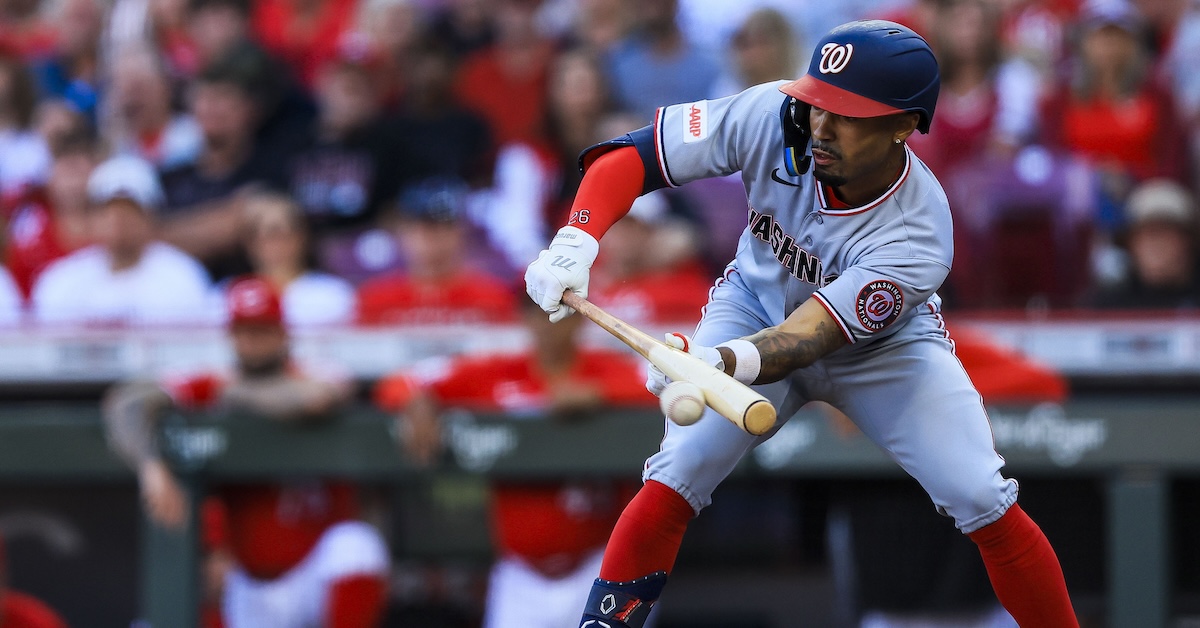 Katie Stratman-Imagn Images
It’s no secret that I’m an obsessive chronicler of bunting in the big leagues. Very good and very bad bunts frequently populate my Five Things column. I’ve written about the best and worst bunts you’ll see in a season, the optimal strategy for bunting in extras, and any number of other interesting bunting-related things – or at least, bunting-related things that are interesting to me. And there’s another great bunting topic to write about right this instant. See, bunts are making a comeback, and for once, they’re doing it for the right reasons instead of the wrong ones. So let’s celebrate the return of the bunt – and also think about why it’s back.
So far this year, batters have bunted the ball into play (or struck out by bunting the ball foul) 640 times. That’s 0.9% of all the plate appearances in the majors in 2026, and while that might not sound like much, it’s a new high in the universal DH era, 25% higher than the 2025 season, which was itself the bunt-heaviest year in that stretch at 0.7%. There were a lot more bunts in the days when pitchers batted in National League parks, of course. But if you limit the search to American League parks and reach into the past, a clear trend emerges. Bunting declined as teams thought more about how bad sacrificing an out is. But then it bottomed out, and now teams are starting to bunt more often:

This is just a chart of how many bunts there are, not how good those bunts have been. In fact, the reason the bunt started to decline in the first place is that many bunts were counterproductive. Sacrificing a runner from first to second at the cost of an out is usually a bad decision on the run-scoring front. It might be a fine fail case – if you fail to bunt for a hit and accidentally sacrifice, that’s not so bad – but pure surrender bunts only make sense in very limited circumstances.
This season’s bunts have been very good, perhaps the best in history. To show you what I mean, consider another graph of bunting in AL stadiums. This one is the leveraged run value per 100 bunts – in other words, it takes into account how many outs there were, how many runners were on base and where, and what actually happened on the play to determine how many runs a given bunt added or subtracted from a team’s expected run scoring. It’s a good time to be bunting:

You Aren't a FanGraphs Member
It looks like you aren't yet a FanGraphs Member (or aren't logged in). We aren't mad, just disappointed.
We get it. You want to read this article. But before we let you get back to it, we'd like to point out a few of the good reasons why you should become a Member.
1. Ad Free viewing! We won't bug you with this ad, or any other.
2. Unlimited articles! Non-Members only get to read 10 free articles a month. Members never get cut off.
3. Dark mode and Classic mode!
4. Custom player page dashboards! Choose the player cards you want, in the order you want them.
5. One-click data exports! Export our projections and leaderboards for your personal projects.
6. Remove the photos on the home page! (Honestly, this doesn't sound so great to us, but some people wanted it, and we like to give our Members what they want.)
7. Even more Steamer projections! We have handedness, percentile, and context neutral projections available for Members only.
8. Get FanGraphs Walk-Off, a customized year end review! Find out exactly how you used FanGraphs this year, and how that compares to other Members. Don't be a victim of FOMO.
9. A weekly mailbag column, exclusively for Members.
10. Help support FanGraphs and our entire staff! Our Members provide us with critical resources to improve the site and deliver new features!
We hope you'll consider a Membership today, for yourself or as a gift! And we realize this has been an awfully long sales pitch, so we've also removed all the other ads in this article. We didn't want to overdo it.
That chart, which only considers AL parks, shows that bunts in those parks have been worth 5.2 runs above average per 100 bunts in 2026. In all parks combined, they’ve been even better, worth 6.0 runs above average per 100 bunts. That sounds good, but how good? Well, the average batted ball in 2026 has been worth 4.7 runs above average per 100 balls in play (avoiding strikeouts, it turns out, is good). That mark has bounced around between 4.5 and 6.0 over the past decade. The average bunt is actually better than the average ball in play, and the average ball in play might be a home run. That’s pretty impressive, honestly.
What’s changed to make bunts so dang good? Two things, primarily. First, roughly a third of bunts in the majors this year have resulted in base hits. That’s amazing – and it’s not even all that new. In the six years of the universal DH, bunts have only turned into base hits less than 30% of the time once. The 2026 season is smack on the average of those six years, in fact. But that’s still really good, and it’s a key part of what has started to turn the bunt’s reputation around. If you’re just giving yourself up, it’s probably a bad idea. But if you can bat .333 on bunts while also sometimes giving yourself up when your bunt is worse than expected, that’s a lot more interesting.
Second, even when bunters don’t reach base safely, they’re successfully moving runners over more often. This season, 41.9% of bunts have moved the runner over successfully, either via a pure sacrifice or via a fielder’s choice that the defense couldn’t turn (think trying but failing to get the lead runner). Chuck in errors and hits, and 74.1% of bunts have produced something positive for the batting team. That’s the highest mark of the universal DH era.
Okay, so bunters are reaching base safely more often, and successfully moving the baserunners up more often even when they fail. But it gets even better! Bunters are also choosing better situations to lay one down this year. It isn’t great to bunt when you only have a runner on first base, because ideally your bunt would either advance more runners or advance a runner to third with less than two outs. Good news – the rate of bunt attempts with a runner on first and no other baserunners is one of the lowest in history this year. Similarly, it’s great to bunt with a runner on third, because even an out can score that runner. Guess what? More than 10% of in-play bunts this year have come with a runner on third, the highest mark in history by a mile.
Even those squeeze bunts are coming in better spots than ever before. With no one out, I’m not a big fan of the squeeze play. With two chances at driving the runner home, surrendering an out is less enticing; why not let at least the first batter swing away? Turns out that teams agree! Squeeze bunts with no one out haven’t budged this year. The entire increase in bunts with a runner on third has come in one-out situations.
Even better from the offense’s perspective, the right guys are doing the bunting. Hitters who have bunted this year have produced a weighted 82 wRC+ in their non-bunt plate appearances. In other words, the average bunt is laid down by a below-average hitter, which means the bunts are even a little better than the raw run value numbers. Interestingly, that 82 wRC+ is a match for 2025, even though there have been many more bunts so far this year. It’s not because great hitters were bunting and stopped; it’s because the increase in bunts has come from the light-hitting contingent of the league, exactly as it should.
Who’s leading this increase in bunting? You’ve surely already heard of the Rays’ bunt-happy ways, and they do indeed lead the league in bunt rate, at 2.1% of their plate appearances. Eight other teams have eclipsed 1% so far: the Brewers, White Sox, Diamondbacks, Reds, Cardinals, Rockies, Red Sox, and Royals. These teams are largely fast, and largely young, but there’s no clear through-line beyond that.
The best bunting team on a per-bunt basis? That’d be the Braves. But that’s misleading; they’ve only dropped down 10 bunts this year, one of the lowest marks in baseball. They succeed by picking their spots. The best high-volume bunting team is the Nationals, who are just below the 1% cutoff that the nine teams above hit. Led by frequent and excellent bunter Nasim Nuñez, who has more than half of Washington’s bunts, they’ve produced a ridiculous 10.5 runs above average per 100 bunts. A lot of that comes from successful squeeze bunts, but that’s true for every team. The Nats have just been very effective at picking their spots – and they also have a lot of team speed, and a lot of hitters who should probably consider bunting.
Will this trend continue for the rest of the season? I sure hope so. It’s hard to predict, because this isn’t a static equilibrium. Defenses can change what they do. Summer weather might change the incentives for a marginal hitter who is deciding whether to bunt or swing away. But at the moment, this is the best that bunting has ever been.


![[Higlight] Chad Patrick gets the K and the Brewers win the 12 inning battle](https://external-preview.redd.it/OW84ajNzMHk5NzZoMaJTg6OJAqra-kYM6943cxwmGeQwisN1I9Px9068VdRY.png?width=640&crop=smart&auto=webp&s=905e8c95f20e07b9d3fb4b2783b0ad34a8666cb3)

![[HIGHLIGHT] 14-14! JONAH HEIM TIES IT UP!](https://external-preview.redd.it/YjUxcWRxYjQzNzZoMbvoUqfDCsVxVDEU04wh_JMz_R6I6SxpGlKegG0W4GqD.png?width=640&crop=smart&auto=webp&s=d803072308b584dd5c6b1f799e1163dc456f7113)

![[Highlight] WILLIAM CONTRERAS 3-RUN HOME RUN OFF THE SCOREBOARD!](https://external-preview.redd.it/cjkxdzAzbjEwNzZoMVtLMtHYthcaRdZMhXHNPxyQKReBKWd131zxitnoPaxL.png?width=640&crop=smart&auto=webp&s=b990cf7233fe24fd6465890ca3d8b86e00019027)







 English (US) ·
  French (CA) ·