

 1 day ago
1
1 day ago
1
PROTECT YOUR DNA WITH QUANTUM TECHNOLOGY
Orgo-Life the new way to the future Advertising by Adpathway
A motion offense is a basketball offense that uses rules and principles to help players read the defense and make their own decisions, instead of running scripted set plays.
It's built on spacing, cutting, screening, and constant ball movement, and it can be run out of a 5-out, 4-out, or 3-out alignment depending on your personnel.
This page covers what a motion offense actually is, where it came from, the five types you can choose from, how to teach it from scratch, and why most motion offenses break down.
What Is a Motion Offense in Basketball?
A "motion offense" is an offensive strategy that uses 'rules' or 'principles' to help players read the defense and make decisions.
It usually involves a lot of passing, screening, cutting, and it always requires great spacing.
The best way to understand what that means is to compare it against the other two things you could run...
Set plays tell your players exactly what to do. Where to screen, when to cut, who to pass to. You draw up the sequence, they run it, and it either works or it doesn't.
Continuity offenses (like the flex offense) give your players a pattern instead of a script. They cycle through the same actions over and over until something opens up. There's more freedom than a set play, but the possession is still mapped out before it starts.
Motion offenses give your players rules instead of a sequence, and there are many variations. How far apart to space, what to do after every pass, which cuts and screens belong in your offense, and how to attack a defender who's denying them or sagging off them. What those rules never do is tell a player what to do next. They teach them how to decide.
That's the real difference between the three, and it's why two possessions of good motion can look completely different from each other.
Why Coaches Should Run a Motion Offense:
1. Great For Long-Term Development
Allowing your players to learn how to read the defense and make decisions is the most important reason to run a motion offense.
It teaches them how to play basketball rather than how to follow instructions, which is fantastic for every player's basketball IQ.
2. All 5 Players Contribute to the Offense
A motion offense requires all five players contributing to be successful.
That doesn't mean everyone needs to dominate the basketball, either.
Even if a player doesn't touch it on a possession, their spacing, cutting, and screening is still creating scoring opportunities for their teammates.
3. Wears Down the Defense
If your players are cutting hard, setting strong screens, and moving the basketball quickly around the court, the defense is going to fatigue and break down very quickly.
Five players moving with purpose is exhausting to guard for a full game.
4. Difficult For Opposition Teams to Scout
When you're running an offense that involves players making decisions based on the defense, there's not much for the opposition to prepare for.
If the defense cuts off one option, your players simply execute a counter. For example, if the defense overplays the pass to the wing, that player can back-cut and then fill the corner while their teammates rotate around.

The 5 Types of Motion Offense
Here are five different motion offenses you can choose from depending on your team’s strengths, weaknesses, and the skills of your players...
The 5-out motion offense puts all five players on the perimeter with nobody inside. One player at the top, one on each wing, one in each corner.
This is the offense I recommend for most youth and high school teams, as it creates lots of space for players to drive and finish at the rim.
It's also the only one of the three alignments that's genuinely positionless. There's no fixed role anywhere on the floor, so every player has to be able to fill every spot. Your point guard might end up in the corner. Your centre might end up at the top of the key. That's the whole idea, and it's the best thing you can do for a young player's development.
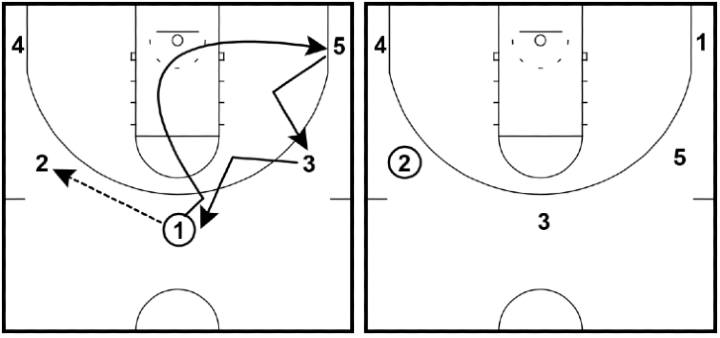
The 4-out 1-in motion offense uses four perimeter players and one post player. A player in each slot, a player on each wing, and a player on the low block.
It gives you plenty of space around the three-point line while still giving the offense a target inside. The trade-off is that a post player who doesn't understand spacing will clog the driving lanes your guards need.
Worth noting for anyone chasing a truly positionless team... this one does have a fixed post role. As long as you're rotating who fills it, I still think it's a great offense.
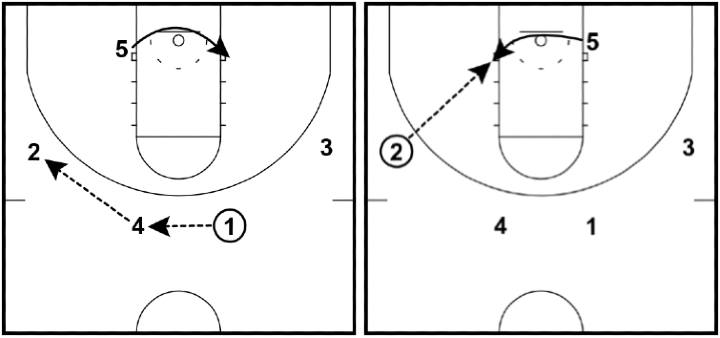
The 3-out 2-in motion offense uses three perimeter players and two post players. One at the top, one on each wing, one on each block.
This offense should only be used by teams with two genuinely high-IQ post players. If you run it, you're committing to getting the ball inside on most possessions and letting your bigs make plays. It gives you good offensive rebounding position and inside-out balance.
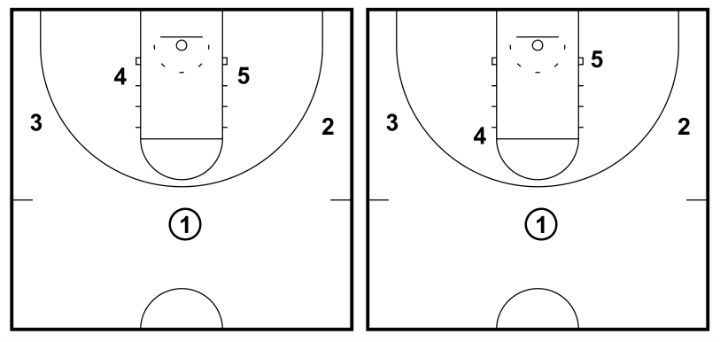
4. Circle Motion Offense
Circle motion is a rule set, and it's almost always run out of a 5-out alignment.
The defining feature is in the name... after passing, players rotate around the perimeter in a consistent direction rather than choosing between several options.
The cutter goes through, and everyone behind them fills up one spot.
Pass, cut, fill. Pass, cut, fill.
Because it's run out of a 5-out alignment, circle motion is positionless in exactly the same way.
What changes is the amount of freedom your players have.
That makes it the most structured of the five, and it's genuinely useful for young teams.
It gives players the spacing benefits of 5-out with a much simpler decision to make, so you can get an organised offense on the floor quickly.
The trade-off is that it's more predictable, and you lose some of the decision-making that makes motion valuable in the first place.
I'd treat it as a stepping stone rather than a destination. Get your team moving and spacing with circle motion, then open the rules up as they're ready.
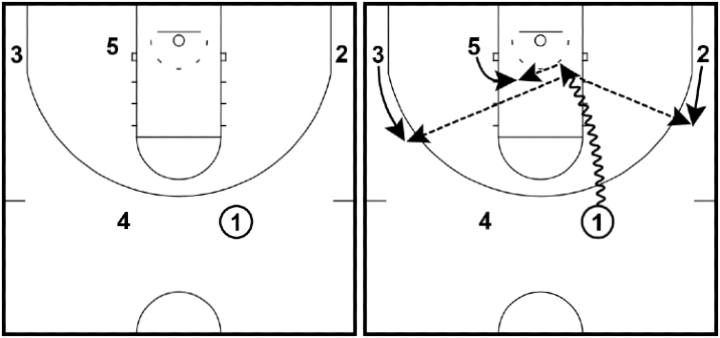
The dribble drive motion offense is the other rule set worth knowing.
It's run out of a 4-out 1-in alignment, but it strips out nearly all of the screening.
Players in the slots and corners, one on the block, and the ball-handler attacks gaps off the dribble while everyone else spaces and reacts.
It's best for teams with aggressive ball-handlers who can break down their defender and get to the rim. If your guards can't beat anyone off the bounce, this offense has nothing to offer you.
7 Keys to a Successful Motion Offense
These seven things determine whether your motion offense actually works.
Two of them flex depending on which offense you're running, and I've noted where.
1. Hard Cuts
Having players that are willing to cut hard - even when they’re not likely to receive the ball - is one of the most overlooked aspects of a successful motion offense.
Cutting with purpose involves four things…
1. Set Up the Opponent - Take your defender away from where you intend to go before you cut.
2. Explode Towards the Hoop - A cut at half speed achieves nothing.
3. Show a Target Hand - Give the passer something to aim at.
4. Clear Out Quickly - If the pass isn't there, get out and fill an open spot immediately.
The obvious benefit is that hard cutters receive the basketball and finish with layups.
Unfortunately that's the only reason most young players think about, which is why you'll see so many of them jog through the lane the moment they decide the ball isn't coming to them.
The not-so-obvious reason has to do with the defense. By cutting hard, a player forces their direct opponent to focus 100% of their attention on denying the cut, which means that defender can't help their teammates and will react too late if another offensive player attacks.
The other defenders are affected too. A hard cut drags help defenders closer to the rim, which often opens up a teammate on the perimeter.
Cutting hard disrupts the defense, and that's what opens up your teammates.
2. Strong Screens
Whether it's a back screen, cross screen, drag screen, elevator screen, or flare screen, a good screen gives someone an advantage.
Depending on where the player is on the floor at the time, that advantage might get them open to receive the basketball, give them an open lane to drive, create the space they need to shoot, or allow them to set up a teammate.
To run a great motion offense, you need effective screening.
3. Quick Passing
Following on from the previous point…
An offense needs to move the ball quickly in order to make the most of the ‘advantages’ created when running a motion offense.
To do this, it’s best to have players who can think 1 - 2 steps ahead of the play…
And since the skill of passing is 90% decision making, this is done by putting players in situations where they need to read the defense and make decisions on what to do next.
Small-sided games are great for this if you’re coaching a young team.
Once your players develop the ability to quickly read the defense and then make the smart play, the ball will be zipping around the perimeter in no time.
4. Smart Spacing
As the ball moves around the court, your players need to keep moving too.
It’s important your players maintain good spacing on every possession.
This involves offensive players distancing themselves from each other at lengths that make it difficult for defenders to provide help without giving up an open shot, drive, or layup.
Correct spacing will depend on the motion offense you choose to run.
5. Purposeful Dribbling
Too much unnecessary dribbling will any hurt any offensive team regardless of what offense their team is attempting to run.
But too much dribbling is especially problematic if you’re trying to run a motion offense.
This is because the ball needs to be moving quickly to ensure all cuts, screens, and the movement of players is effective.
Rick Majerus once said there are 3 reasons to dribble:
- Acquire balance.
- Break 5 second count.
- Make the dribble take you somewhere.
Players executing a motion offense need to remember this at all times.
6. Positionless Players
When all of the players on your team have the ability to fill every position on the floor, motion offense is much easier to run.
That’s not to say that your players will play every position…
For example, you likely won’t use your PG in the post when playing a 4-out 1-in motion offense.
But all of the players on your team could fill any position if necessary.
This is also one of the best thing you can do for each player’s basketball development.
7. Constant Movement
When you put all these “keys” together…
The outcome should be an offense with hard cuts, strong screens, quick passing, smart spacing, and purposeful dribbling.
The goal is then to make sure players are constantly moving throughout the offense.
How to Teach a Motion Offense
Anyone who has coached a group of under-10s playing 5-on-5 knows it's absolute chaos.
All ten players sprint towards the basketball and then stand within ten feet of each other screaming for the pass.
Which means there's nobody to pass to, and the other team steals it over and over again.
So how do you get from that to a real offense?
1. Teach it in progressions
This is the part most coaches skip. Many think that installing an offense means teaching cutting, screening away, on-ball screens, hand-offs and every other action all at once. You don't.
Progression #1 of the 5-out motion is passing and cutting. That's it. No screening, no hand-offs, no drag screens, none of the actions that will only confuse young players.
And this is the important part: a team of any age can learn pass and cut.
Progression one on its own gives you great spacing, gets your players reading the play, and is a completely functional offense for a youth team.
Then you add the next layer when they're ready.
2. Pick one motion offense and commit to it
I'd recommend the 5-out for almost every youth team.
Go with 4-out 1-in if you're coaching an older group and have a genuine post player, or circle motion if your group needs something simpler to start with.
What matters far more than which one you pick is that you stick with it.
3. Don't move up until they've mastered the progression they're on
The temptation is to add the next layer as soon as your players can get through the current one without falling over. Resist it.
Make sure they're running the current progression well before adding anything new.
A team running progression one properly will beat a team running four progressions badly.

Why Your Motion Offense is Breaking Down
Most motion offenses don't fail because the offense is wrong.
They fail for one of these reasons.
1. The Offense Doesn't Fit Your Roster
Your offense should be determined by the players on your roster, not by whatever you happen to enjoy running.
Which means the first step is to evaluate your roster HONESTLY, before you give any thought to spacing or structure.
The most common version of this mistake is a coach committing to a 3-out 2-in without two genuinely skilled post players.
The result is a team feeding the basketball inside to bigs who can't finish, while the guards who should be attacking stand and watch.
The offense isn't the problem. The fit is.
Ask yourself one question before you lock anything in: is this offense for you, or is it for the team?
2. You Keep Switching Offenses
The opposite failure, and just as common.
It usually happens like this:
A coach installs the 3-out 2-in through pre-season, loses the first couple of games, and switches to the 5-out.
That goes better until the post player struggles on the perimeter, so it's on to the 4-out 1-in.
That's three offenses in one season, and the players never get comfortable with any of them.
Your players need time and experience to learn an offense. There's no chance your team makes significant progress if you aren't willing to commit to something and stick with it. You can make small changes along the way, but the bulk of your system should stay the same.
3. Your Players Create Advantages and Then Waste Them
The only reason we run an offense at all is to create an advantage.
In a 5-out, for example, one of the ways we create an advantage is through smart ball movement that leads to a late closeout for the defense.
That late closeout is the advantage we were seeking, and when it happens we want the player with the basketball to abandon the offense.
They should now either shoot if they're open, drive against the closeout, or pass to an open teammate if another defender has rotated to help.
So the goal is never to run your offense forever...
It's to run it until a good advantage has been created, and then capitalise on it before the defense has time to recover.
In short, there are two steps…
Step 1: Create an advantage.
Step 2: Use the advantage to create a great shot.
Most teams are reasonably good at step one, even if it happens by accident. It's step two where everything falls apart.
Players either don't realise they have an advantage, they keep running the offense when they should be attacking, or they hesitate just long enough for the defense to recover.
Teaching your players to recognise and then capitalise on an advantage before the window closes is the difference between an offense that looks good and an offense that scores.
4. Nobody's Holding a Standard on the Little Things
Four things kill an offense faster than anything tactical…
1. Lazy Screens - A screen that doesn't make contact doesn't create an advantage.
2. Slow Cuts - A cut at half speed tells the defender they can go and help elsewhere.
3. Lack of Movement - Players standing and watching the ball-handler work.
4. Holding the Ball - Every second the basketball sits still, the defense recovers.
None of those are complicated, and none of them are drill problems. They're standards you set with your team.
Talk to your players about why each one matters and then hold them accountable, emphasising it in every drill and game you run at practice. If a player refuses to cut hard on every possession, use the bench to show them it's unacceptable.
Motion Offense Drills
The drills that rehearse your specific actions and alignment will depend on which of the five offenses you're running, so you won't find those here.
What you will find are drills for the underlying skills, and those carry across all of them. Cutting, spacing, screening, reading the defense, and moving the basketball are required no matter which offense you choose, and these are the ones worth building your practices around.
No-dribble games. Play 3-on-3 or 4-on-4 with dribbling banned entirely. Players have to cut and screen to get open because there's no other way to move the ball. Nothing exposes lazy cutting faster.
Pass-and-move constraint. Play a small-sided game where standing still after a pass isn't allowed. The passer has to cut, screen, or relocate. Whichever actions belong in your offense are the ones you enforce. Standing still is a turnover. This makes your after-the-pass rule automatic.
Ball reversal. Require a set number of side-to-side reversals before the team is allowed to shoot. Forces patience and gets everyone touching the ball.
Advantage finishing. Create an advantage artificially (start the defense in rotation, or in a late closeout) and let your offense attack it. This is the "step 2" work almost nobody practices.
For a broader collection, our basketball drills page has options for every age group, and the passing drills page covers the decision-making side in more depth.
Motion Offense FAQ:
What is a motion offense in basketball?
A motion offense is an offense that uses rules and principles to help players read the defense and make their own decisions, rather than running scripted set plays. It relies on spacing, cutting, screening, and constant ball movement, and it has no repeating pattern.
Who invented the motion offense?
It's generally credited to Henry Iba at Oklahoma State. Bob Knight developed and popularised the version coaches run today, working it out with Pete Newell after studying the Princeton offense and the passing game, and publishing his rules in a 1975 booklet.
What are the different types of motion offenses?
Five. The three base alignments are 5-out, 4-out 1-in, and 3-out 2-in, named for how many players start outside and inside. Circle motion and the dribble drive are motion offenses with specific rules layered on top.
What are the best motion offense plays?
A motion offense isn't built from plays. The whole point is that your players are reading the defense and deciding for themselves, so scripting the possession defeats the purpose of running it.
What most coaches mean when they ask this is quick hitters... a short set that gets you an early look and then flows straight into your motion when it doesn't produce one.
Those are worth having, but they can't live on a page like this one, because a quick hitter only works out of a specific alignment.
A set built for a 5-out won't function in a 3-out 2-in.
So they belong on the individual offense pages instead.
Pick the offense you run from the five above and work from the quick hitters that fit that alignment.
What's the best motion offense for youth basketball?
The 5-out motion, in my opinion.
It's positionless, which means all five players are required to pass, cut, dribble, shoot, and screen. It creates the maximum amount of driving space. And it can be taught using simple progressions, starting with nothing more than spacing, cutting, and ball movement.
How long does it take to teach a motion offense?
You can have progression one, which is spacing, cutting, and ball movement, running within a couple of weeks with most teams.
Building it out into a full offense with screening and hand-offs takes a season or more.
That's not a reason to avoid it. Set plays are much faster to install, and they teach your players almost nothing.
Does a motion offense work against a zone?
Yes, and it's one of the big advantages of running one.
Because the offense is based on reading the defense instead of running a pattern, the same principles apply against man-to-man, zone, or any junk defense you come up against.
The specific reads change, since you're attacking gaps rather than beating your direct opponent, but you don't need to install a separate offense to handle it.
Conclusion:
A motion offense is fantastic to run if you’re passionate about the long-term development of the individual players on your team.
By giving your players ‘rules’ to follow and then allowing them to make decisions throughout a game, you’ll skyrocket their basketball IQ in a very short amount of time.
But be warned...
It can be a frustrating process.
Your players will make mistakes while they’re learning, and there will be times when you want to give up and return to set plays.
But I encourage you to stick with a motion offense and use it long term.








 English (US) ·
  French (CA) ·