

PROTECT YOUR DNA WITH QUANTUM TECHNOLOGY
Orgo-Life the new way to the future Advertising by AdpathwayHello all!
I'm new to stringing and this forum has been brilliant to help me get started. Thanks to everyone who helps support and respond to threads - it helps so much!
I recently got a GLS-300 frame with a TennisHead 2086 Series 14 head. It came with 5-tooth fixed clamps. I'm trying to dial in the clamp jaw width before I start stringing real rackets, and I've hit a problem I can't resolve.
To test the fixed clamp's holding ability, I clamped a scrap piece of BG65Ti (0.70mm) and pulled it directly with the 2086 at 30 lbs to see whether the clamp holds or slips.
This is the test I saw performed in
What I'm finding:
- At a jaw width wide enough to avoid marking the string, it slips and loses tension.
- At the width where it holds 30 lbs without slipping, the string is visibly flattened
There doesn't seem to be a width that both holds the tension and avoids flattening. I was not able to get a great picture of the string, but I've attached one that might provide more reference.
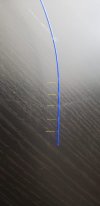
So some questions I had based on my tests were
- Am I wrong to test by pulling directly into the clamp at full tension rather than clamping an already-tensioned string? Or is there any other technique I'm missing to test the fixed clamp width?
- At your normal badminton tensions (mine will mostly be 26-30 lbs including the cross/outer-main bump), does your fixed clamp hold without flattening the string? Is some flattening actually normal and acceptable?
- For those with GLS or similar Chinese 5-tooth clamps specifically — is this a known limitation, or does it suggest a defective clamp?
I want to get this right before I string rackets for anyone. Thanks in advance!

Well, tensioning an untensioned string at full tension means tension is on one side of the clamp, right? The same as when the string is not on the puller, but just the other side is tensioned, right? Those are normal conditions.
I normally don't see a clamped string part untensioned, after. But under tension I can't see any denting in the string. As long as the string is not damaged, I would try to find the lowest setting where the string is not slipping under your max tension plus a margin. Slipping creates more damage than a little denting.
It can also help to clean the grippy parts of the clamp with some alcohol (wipes) or something.
Good luck!!
Well, tensioning an untensioned string at full tension means tension is on one side of the clamp, right? The same as when the string is not on the puller, but just the other side is tensioned, right? Those are normal conditions.
I normally don't see a clamped string part untensioned, after. But under tension I can't see any denting in the string. As long as the string is not damaged, I would try to find the lowest setting where the string is not slipping under your max tension plus a margin. Slipping creates more damage than a little denting.
It can also help to clean the grippy parts of the clamp with some alcohol (wipes) or something.
Good luck!!
Thank you, Thyrif, that's really helpful! Good to know the direct-pull test reflects normal clamp conditions. That was my main worry, so I'm glad the method is sound.
On the denting vs slipping point, that makes sense too - slight marking definitely sounds better than losing tension to slippage.
The one thing I want to make sure of: in my case it's not just light denting - the string cross-section looks visibly flattened at the lowest width that holds 30 lbs without slipping. Does that degree of deformation still fall in the 'acceptable, slipping is worse' category in your experience? Or would that much flattening point to something off with the clamp itself - like the teeth not all contacting evenly, or needing to be dressed/adjusted?
Just want to make sure I'm not signing off on a clamp that's going to weaken strings before I start doing this for others. Thanks again! 
What i mean is that slipping might tear the string apart. I'm not too worried about these dents.

I also figured that a direct pull against a clamp holding a previously untensioned string is the maximum stress you can apply to a string and doesn't really represent a real life use case.
Here's what I do:
Use a real racket and start the string job as you normally would. So for me, that means pulling the two center main strings together, clamp one of it and then pull the other string once again.
Then clamp that string but don't directly release the tension. Before you release the tension, place your finger right at the spot where the string "leaves" the clamp towards the middle of the frame. And then release the tension.
You can then feel really well if the string is slipping out of the clamp or not.
You can repeat this process until you find the exact point at which the clamp starts slipping and then dial in a setup that leaves a bit of margin to that slipping point.
=> You now have your basic setup for the main strings.
If you want to be on the very safe side, you have to repeat the same process once you start the cross strings too. The cross strings are only held by the teeth of the clamp, so there is significantly less actual clamping surface. Again, set it to a point at which the string is clearly not creeping out the clamp after then tension is released.
I 100% agree with @thyrif that a slipping clamp is way worse that one that is set slightly too tight. So I tend to have mine setup comfortably tight.
Agree that slipping is worse than slightly too tight.
However, I'll note a couple of other things that were not mentioned by others:
- clean your clamps properly if they've been used (e.g. you bought the machine used?). When the clamps accumulate even slight gunk they might start slipping way easier
- if the machine was bought used, the clamps might have seen thousands and thousands of rackets and be actually fairly used up
- it is indeed also possible these clamps might not be great even to start with, though I don't have any knowledge of these being known bad clamps
- dark strings like the deep blue tend to show damage easier
Also the process in the video isn't the best IMHO. Whenever you have that kind of slipping on a string while testing the slippage, the clamps tend to tear a bunch of the coating off the string and get gunked up. This is especially noticeable on a string like exb65 with a thick sticky coating that comes off easy. I'd personally clean the clamps immediately after seeing that kinda slippage as shown on the video. I'd also use a different portion of the test string on the next test to clamp on, instead of the same now-possibly-coating-stripped portion of the string.
While cleaning the clamps you can also look at the wear surface / gripping surface in case it has any visible issues.
For proper cleaning you can use e.g. a toothbrush with isopropyl alcohol. I personally tend to use a philips sonicare because the vibration is great for this kind of cleaning, but that's overkill if you don't already own one.
Yeah the aerobite sticky main string is also prone to removing the outer sleeve when slipping.

For proper cleaning you can use e.g. a toothbrush with isopropyl alcohol. I personally tend to use a philips sonicare because the vibration is great for this kind of cleaning, but that's overkill if you don't already own one.
I actually started using this, used the more worn out brush heads before tossing them to clean the clamps. My process is around every 20-30 rackets I would take the normal tooth brush and just brush the clamps and any dust that could easily be brushed off. The electronic tooth brush is only maybe every 2 months tho. I don't notice much heavily buildup, and maybe every 4 months I'll use alcohol swabs to give it a little wetdown.
+1 on the exbolt65 coating being shredded or completly torn off the middle of the string. Exb63 does this for me as well and recently for some reason on my starting clamps aerobite even tho thicker and has a sticky coating gets shredded with I extend. Have to deal it a bit tighter on my starting clamp yet other strings are fine.
My fixed clamps also dent the strings a bit when clamping and now I basically used one setting for all strings. Before I had 2 settings a looser and the current one. But the looser one was starting to slip on mains as time went on so now I only kinda use it for 0.7m strings or thicker and don't exceed 26lbs but its like once a full moon. I also go one notch tighter for aerosonic or thinner at 29lbs+ but thats also once a full moon as well.
I also figured that a direct pull against a clamp holding a previously untensioned string is the maximum stress you can apply to a string and doesn't really represent a real life use case.
Here's what I do:
Use a real racket and start the string job as you normally would. So for me, that means pulling the two center main strings together, clamp one of it and then pull the other string once again.
Then clamp that string but don't directly release the tension. Before you release the tension, place your finger right at the spot where the string "leaves" the clamp towards the middle of the frame. And then release the tension.
You can then feel really well if the string is slipping out of the clamp or not.
Thanks, this is super helpful!
I had seen another video (tennis racket stringing, but same process) that talks about this specifically.
Being new to this and all, I just wasn't sure how folks calibrated their clamps, but this is good to know, thank you!
However, I'll note a couple of other things that were not mentioned by others:
- clean your clamps properly if they've been used (e.g. you bought the machine used?). When the clamps accumulate even slight gunk they might start slipping way easier
- if the machine was bought used, the clamps might have seen thousands and thousands of rackets and be actually fairly used up
- it is indeed also possible these clamps might not be great even to start with, though I don't have any knowledge of these being known bad clamps
- dark strings like the deep blue tend to show damage easier
Also the process in the video isn't the best IMHO. Whenever you have that kind of slipping on a string while testing the slippage, the clamps tend to tear a bunch of the coating off the string and get gunked up.
Thank you for the reply, this is helpful to know
I used a regular toothbrush dipped in isopropyl alcohol to scrub the clamps before running the tests.
My stringing machine/clamps are new. Not sure if this is helpful information, but it's a GLS Gelinshi machine with a TennishHead 2086 puller. I purchased it from China. Thanks again!












 English (US) ·
  French (CA) ·