

 1 day ago
4
1 day ago
4
PROTECT YOUR DNA WITH QUANTUM TECHNOLOGY
Orgo-Life the new way to the future Advertising by AdpathwayPublished September 3, 2026 10:54AM
In Yoga Journal’s Archives series, we share a curated collection of articles originally published in past issues beginning in 1975. This article about Standing Forward Bend (Uttanasana) first appeared in the January-February 1982 issue of Yoga Journal. Find more of our Archives here.
When we begin the practice of yoga, we are conscious primarily of our physical body—our muscles, joints, and bones—which we experience through the sensations of stretching, twisting, and bending and the cognitive demands of reorienting ourselves in space. As our practice evolves, we become aware at a subtler level of different qualities of energy in the body—the stimulation that occurs with backbends, the calming nature of forward bends, the poised alertness of headstand.
The ancient yogis equated the heating or dynamic energy of the body with solar energy and the cooling or restorative energy with lunar energy. For them, the purpose of hatha yoga was to unite these two energies through the discipline and transformative power of the asanas. In fact, the esoteric meaning of the word “hatha” relates the syllable “ha” to the sun (surya) and “tha” to the moon (chandra), while yoga is the union between these two principles.
The balance of solar and lunar energies can be most readily experienced in Uttanasana (Standing Forward Bend), where the dynamic lift of the legs allows for a passive release of the torso. The upper body and lower body come together like the sun and moon approaching an eclipse. “Uttanasana” literally means “intense stretch pose,” because the spine and the back of the legs are stretched to the maximum. Yet despite the outward or surface intensity of the pose, the inward feeling is one of deep quietness—a return to a place of nourishment.
How do we achieve this perfect equilibrium? According to B.K.S. Iyengar, we begin by bringing every part of the body into proper balance. In The Tree of Yoga, Iyengar explains that in each part of the body, solar energy runs along the outer edge, which is more exposed to the world; lunar energy travels along the inner edge, nearer to the core of the body; and the bone that is in the middle represents the median line. “Suppose you are stretching the index finger in an asana; if the outer edge of the index finger stretches more, and the inner edge does not stretch so much, that means the solar energy is flowing more and the lunar energy less. You must pay attention to the lunar energy so that the excess of solar is nullified.”
For most of us in the West, solar energy dominates our actions. When we raise our arms overhead, we lift from our outer arms, an action that hunches the shoulders, rather than from our inner arms, which keeps them low and broad. We walk more on our outer legs than our inner legs, which makes our feet turn out and tightens the outer buttocks. Even the shape of the calf muscle changes when the weight falls constantly on the outer leg. The outer calf muscle becomes bulky and hard, while the inner calf muscle is thin, flat, and underdeveloped.
How to Practice Standing Forward Bend (Uttanasana)
The following variation of Uttanasana helps to strengthen the inner calves and restore balance to the legs. Start in Tadasana with your hands on your hips and your feet a few inches apart. On an inhalation, lift through the crown of the head and strengthen the legs. On an exhalation, allow the pubic bone to roll back between the thighbones, as you lengthen the spine forward into Uttanasana. Now make two fists with your hands and place them between your inner calves just below the inner knee. Firm your inner calf muscles against your fists, but keep the heads of the thighbones moving apart from each other, so the groins remain soft and the pelvis wide. Continue to firm the inner calves.
Notice how your body responds to the adjustment. If your weight shifts forward so the hips are more in line with the ankles, you know that the work of the inner calves is helping to bring the pose into better alignment. Hold the position for several more breaths. Then bring your hands back to your hips and with a deep inhalation return to a standing position.
This variation of Uttanasana can be especially helpful for students with hyperextended knees. Hyperextended knees are caused by jamming back the shinbones without any corresponding lift of the thighs. The knee joint is locked beyond its natural limit, often causing pain either at the back of the knee, where the top calf muscle becomes thick and knotted as it crosses the back knee joint, or at the front of the knee, where the kneecap grates uncomfortably against the front of the knee joint. As the shinbones dig back, the weight falls onto the outer calf muscles, making them hard and overdeveloped and giving a bow-legged appearance to the lower legs. Strengthening the inner calves will help to counteract this tendency.
Students with hyperextended knees are often told to keep their knees slightly bent in Uttanasana to avoid discomfort. This technique may temporarily alleviate the problem, but it does not provide a long term solution. In my experience, most students with hyperextended knees have overworked the knee joint but have neglected the muscles at the back of the knee. The following variation of Uttanasana focuses on strengthening the muscles at the back of the knee in order to balance the legs and take the weight off the knee joints.
 (Photo: Yoga Journal 1982)
Stand in Tadasana with your hands on your hips and your feet directly under the hip sockets. Lift the outer arches of the feet and lengthen the inner thighs as you come forward into Uttanasana. Place your hands on the back of the calves just below the back of the knee, broadening your palms against the bulky part of the calf muscle to help stabilize the lower leg (Figure 1). Allow the back of the calves to widen and at the same time stretch the back thigh muscles (the hamstrings) up away from the knee crease. As the hamstrings become longer and stronger, you may find that the weight of the hips shifts forward over the ankles, allowing the spine to descend even further.
Now place your palms on the floor, or take hold of the elbows, and try to maintain the sensation at the back of the legs—the calf muscles broadening and the back of the thighs lifting up away from the knees. Hold the pose until the breath becomes quiet. Then bring your hands back onto your hips and with a deep inhalation return to a standing position.
Most yoga students understand how tight hamstrings limit forward bending by restricting the rotation of the pelvis. However, many don’t realize that tightness and gripping of the outer hips also limit forward bending, while placing a great strain on the sacroiliac joints. You can experience this effect for yourself by standing in Tadasana (Mountain Pose) with the feet together and trying the following experiment. First squeeze the buttocks as though you were tucking the tailbone under. Then come forward into Uttanasana. If you maintain the grip of the outer buttocks, you will barely move a few inches before you feel the backward tug on the pelvis and the strain on the lower back.
Now come back into Tadasana and place your hands on your outer hips. This time, as you bend forward into Uttanasana, use your hands to roll the flesh of the outer hips toward the front hipbones so that the muscles of the outer hips broaden and release. Feel how the heads of the thighbones widen apart from each other, creating space for the pelvis to move between them. For those who suffer from sacroiliac pain in Uttanasana, this action often helps to relieve the discomfort.
The following variation of Uttanasana helps to stretch the outer hips and lengthen the outer waist. Stand in Tadasana with the feet parallel and a few inches apart. Place your hands on your hips with the thumbs on the sacrum and the fingertips pressing the front hipbones. Lengthen the front spine as you come into Uttanasana, rolling the outer hips forward with your hands and letting the pubic bone move back between the thighbones.
Now take hold of the outer right calf with the left hand. Turning the left side of the torso toward the right leg, draw the lower abdominal muscles toward the right thigh. Press your right hand on the outer right leg to help stabilize the pose. Let the left shoulder blade release from the rib cage as you lengthen the left elbow down to the floor. You will feel the stretch all along the left side of the spine and across the outer left hip (Figure 2). Hold for several breaths and then repeat to the other side, noticing any difference between the right side and the left.
The next variation of Uttanasana helps to bring the hips directly above the ankles, so the weight of the body is balanced evenly between the front of the feet and the heels. First take a blanket, towel, or mat and make a firm roll about three inches in diameter. (You may need to adjust the size of the roll if you find it uncomfortable.) Then stand in Tadasana with the feet a few inches apart, directly underneath the hip joints. Hold the roll against the front hip crease with both hands. As you start to bend forward, press the roll slightly upward, so the lower abdomen is not trapped behind the roll, but lifts over it in the direction of the navel. When the roll is held securely between the thighs and the pelvis, release your hands and take hold of the elbows, or, if you are more flexible, place your palms on the floor (Figure 3). More advanced students can bring their hands onto the inner calves, with the elbows bent out to the side. Releasing the shoulder blades from the spine out toward the elbows, draw the ribcage closer to the legs. Keep the chin slightly tucked so that the base of the throat remains soft. When you feel ready to come out of the pose, take hold of the roll once again, lengthen the spine, and lift the torso from the lower abdomen.
 (Photo: Yoga Journal 1982)
This variation of Uttanasana is also helpful for students who have tightened the inner groins by continually tucking the tailbone under and overflattening the lumbar spine. When you observe these students in Uttanasana, the lower back looks hard and flat, and the lumbar spine has virtually no curve. To compensate for this unnatural flatness of the lumbar, there is often an excessive rounding of the thoracic spine, and the whole upper back appears tense and constricted. Working with a roll at the lower abdomen helps to create a gentle rounding of the lumbar spine, which softens the flesh of the whole lower back. With this gentle rounding of the lumbar, the whole of the spine is free to lengthen, and the hunched-over arc of the upper back is softened to a long, harmonious curve that follows the line of the lumbar. The roll at the lower abdomen helps to awaken the deeper abdominal muscles and to shift the center of balance from the inner groins to the true physical center just below the navel.
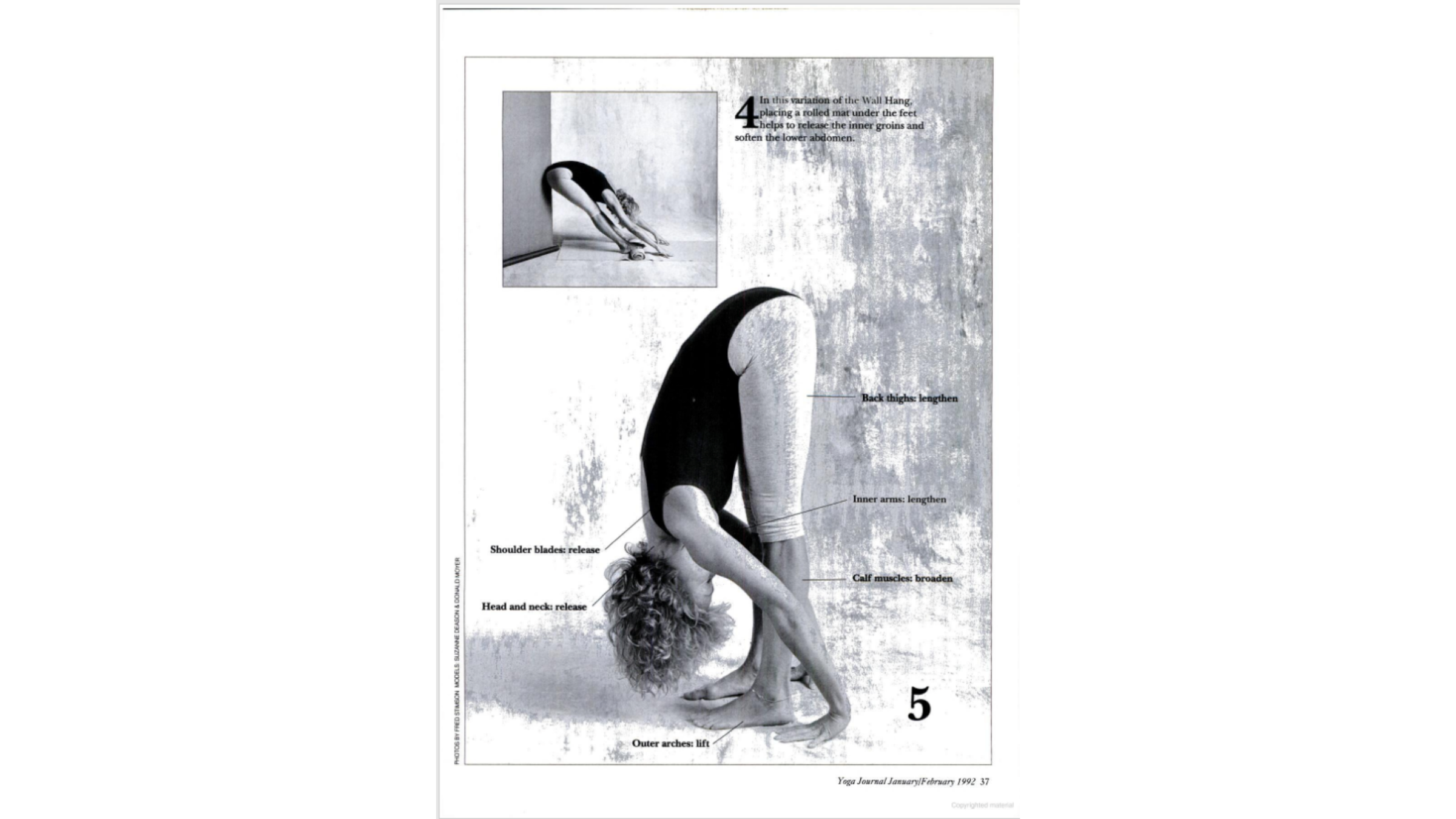
The next variation of Uttanasana, with the sitting bones resting on a wall, is often referred to as a Wall Hang. I prefer to practice this variation with a lift under the feet (Figure 4), because this support allows me to release more deeply into the pose. First stand in Tadasana with your back to a wall, your heels about 18 inches from the wall, and your feet body-width apart. Come forward into Uttanasana and place a firmly rolled mat (a sticky mat is best because it doesn’t slide) under your arches, so the balls of the feet are raised up on the roll. Bring your hands onto the wall behind you and rest your buttocks back on the wall, drawing the flesh of the lower back up toward your waist so the sitting bones are in firm contact with the wall. Then extend your arms forward with your fingertips resting on the floor, lengthening the inner arms as you press the sitting bones into the wall.
When the spine is fully lengthened, bend your elbows toward the wall and bring the palms of the hands onto the floor directly under your shoulders. Release the shoulder blades away from the spine and lengthen the back of the arms out to the elbows to help soften and widen the upper back. Keeping the outer arches lifting, draw the thighbones up into the center of the hip sockets and allow the torso to rest on the thighs. Stay in this pose for one to two minutes, releasing deeply with each exhalation. When you feel ready to come up, bring your hands back onto the wall and push yourself forward to a standing position.
If you have hyperextended knees and experience discomfort in this pose, try moving the feet and the rolled mat a few inches further from the wall so you feel the stretch at the top of the back thighs rather than at the back of the knees or calves. Those who are very stiff in forward bends or who have lower back problems can place a chair or bench in front of them to rest their forearms on.
For me, the lift under the front feet allows the inner groins to soften and the lower abdomen to relax, so that the pelvis sinks in between the thighbones. I often practice this variation of Wall Hang before starting a sequence of sitting forward bends, and especially before practicing Paschimottanasana (Sitting Forward Bend), because it helps me to move more deeply and comfortably into these challenging poses.
In the preceding variations of Uttanasana, we have focused on balancing different parts of the body. Now we can integrate these insights into our practice of the full pose (Figure 5). Stand in Tadasana with the big toes together and the heels slightly apart. On an inhalation, raise your arms overhead and release the shoulder blades away from the rib cage as you lengthen the upper inner arms firmly along the bone. On an exhalation, extend your torso forward, allowing the pubic bone to move back between the thighbones, so you feel the widening of the outer hips.
Now take hold of your elbows or, if you are more flexible, place your hands on the floor by your outer feet. Lengthen the outside edges of the feet from the heel toward the little toe and lift your outer arches to help you lengthen the inner thighs. Broaden the back of the calves and lift the back thigh muscles away from the crease at the back of the knee. Draw the inner groins up evenly into the body, so the pelvis lifts over the heads of the thighbones and the spine descends easily. Let your shoulder blades release away from the ribcage as you lengthen the upper arms out toward the elbows. Keep your eyes soft and let the head hang freely. Maintain the active lift of the legs, but bring your awareness deep into the core of the body and observe how the muscles of the lower abdomen sustain you in the pose. Let the breath be quiet. Release more deeply into the pose with each exhalation. When you have reached a place of stillness, extend the arms forward, and with an inhalation return to a standing position.
The practice of yoga is essentially about achieving balance in our lives: balance between the right side and left side of the body; balance between the body and the mind by the cultivation of awareness; between our commitments to the outer world of work, family, and relationships and the inner life of the spirit; between stimulation and repose; between solar energy and lunar energy. Out of this balance a new energy is born, the transcendent energy known in yogic tradition as kundalini.










 English (US) ·
  French (CA) ·