

 7 hours ago
1
7 hours ago
1
PROTECT YOUR DNA WITH QUANTUM TECHNOLOGY
Orgo-Life the new way to the future Advertising by AdpathwayPublished August 2, 2026 06:40AM
Yoga Journal’s archives series is a curated collection of articles originally published in past issues beginning in 1975. This article about Supta Virasana (Reclining Hero Pose) first appeared in the March-April 1986 issue of Yoga Journal.
Supta Virasana can be practiced as a preparation for pranayama (breathwork); as a preparation for backbending asanas; as a counterpose after a forward bending series; as an aid to digestion after meals; or as a way of relieving the legs after long hours of standing or walking.
One of the benefits of the pose is the deep stretch it gives to the quadricep femoris muscle. This muscle lies on the anterior (front) thigh and tends to be strengthened and tightened by many athletic activities. In addition to stretching the quadriceps, the pose stretches the shorter muscles called the iliopsoas group, which, with part of the quadriceps, flex the hip, bringing the femur (thigh bone) toward the chest. The other job of the quadriceps is to extend (straighten) the knee. Thus this pose stretches the muscle at both ends by flexing the knee and moving the hip joint toward extension.
Tightness in the quadriceps and hip flexors makes the backward-bending asanas more difficult by keeping the pelvis pulled toward the thigh instead of allowing it to tip backward to create a more comfortable and complete backbend. In addition, tightness in the anterior muscles of the thigh can interfere with the free movement of the pelvis during walking and can eventually affect the rhythmic movement of the hip joints in such a way that the lower back suffers. This difficulty may be exacerbated in athletes whose activities tighten the quadriceps and whose momentum during movement can add extra strain to the lower back. Therefore, Supta Virasana is an excellent pose for runners and others who do repetitive movement that brings the thigh toward the chest with momentum.
As it tends to open the abdomen and chest, it is a good preparation for breathing exercises and is also good for stimulating the organs of the abdomen, such as the intestines and liver. It can be used as an antidote for nausea, and, when the back is well propped up (even more than shown in Figure 2), pregnant women may find it helpful in relieving morning sickness. (A note of caution: Pregnant women should avoid prolonged backbending after the fourth month to prevent a sudden drop in blood pressure due to compression of the inferior vena cava).
How to Practice Supta Virasana or Reclining Hero Pose
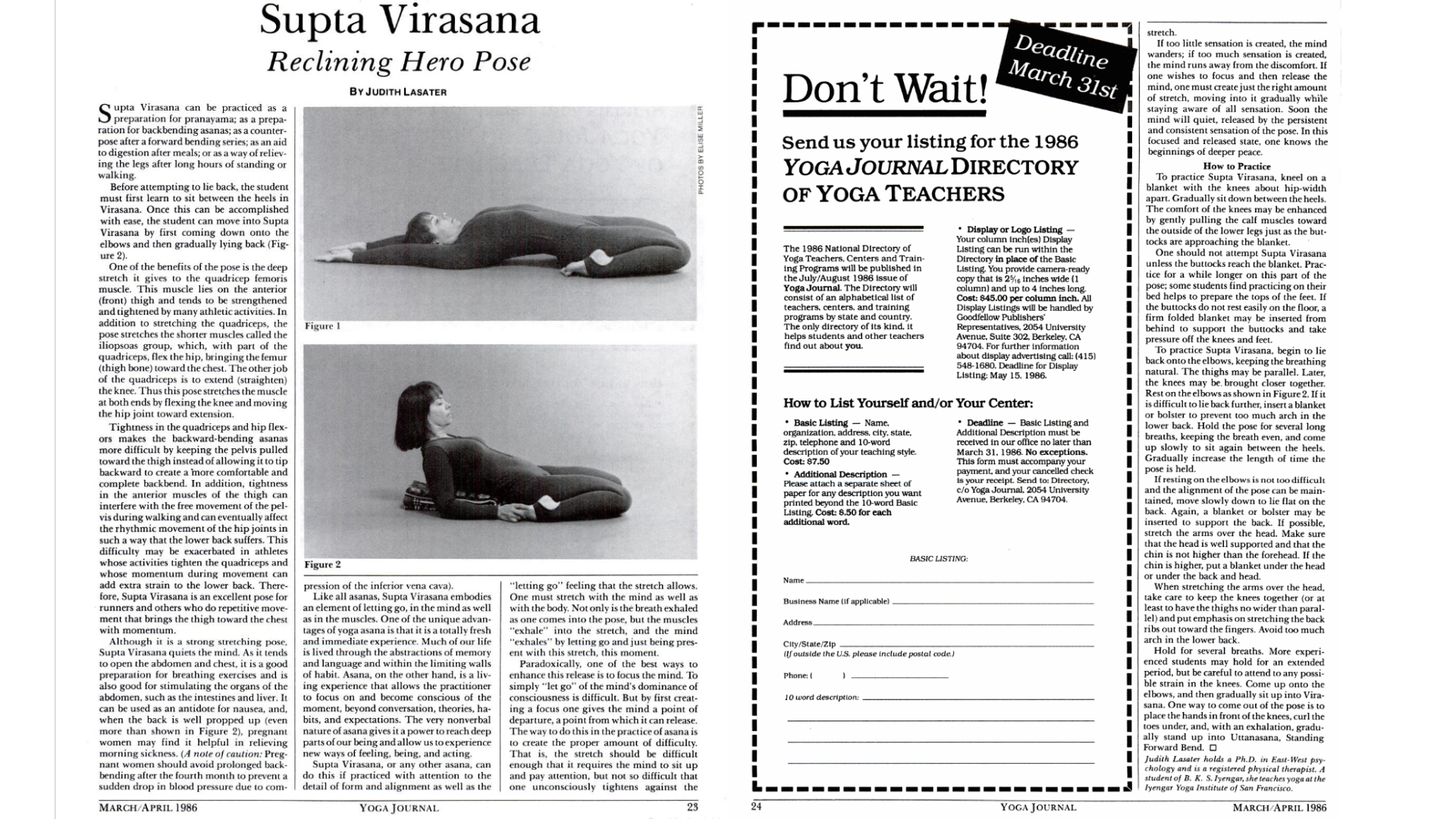
To practice Supta Virasana, kneel on a blanket with the knees about hip-width apart. Gradually sit down between the heels. The comfort of the knees may be enhanced by gently pulling the calf muscles toward the outside of the lower legs just as the buttocks are approaching the blanket. One should not attempt Supta Virasana unless the buttocks reach the blanket. Practice for a while longer on this part of the pose; some students find practicing on their bed helps to prepare the tops of the feet. If the buttocks do not rest easily on the floor, a firm folded blanket may be inserted from behind to support the buttocks and take pressure off the knees and feet.
Before attempting to lie back, the student must first learn to sit between the heels in Virasana (Hero Pose). Once this can be accomplished with ease, the student can move into Supta Virasana by first coming down onto the elbows and then gradually lying back (Figure 2).
Begin to lie back onto the elbows, keeping the breathing natural. The thighs may be parallel. Later, the knees may be brought closer together. Rest on the elbows as shown in Figure 2. If it is difficult to lie back further, insert a blanket or bolster to prevent too much arch in the lower back. Hold the pose for several long breaths, keeping the breath even, and come up slowly to sit again between the heels. Gradually increase the length of time the pose is held.
If resting on the elbows is not too difficult and the alignment of the pose can be maintained, move slowly down to lie flat on the back. Again, a blanket or bolster may be inserted to support the back. If possible, stretch the arms over the head. Make sure that the head is well supported and that the chin is not higher than the forehead. If the chin is higher, put a blanket under the head or under the back and head.
When stretching the arms over the head, take care to keep the knees together (or at least to have the thighs no wider than parallel) and put emphasis on stretching the back ribs out toward the fingers. Avoid too much arch in the lower back.
Hold for several breaths. More experienced students may hold for an extended period, but be careful to attend to any possible strain in the knees. Come up onto the elbows, and then gradually sit up into Virasana. One way to come out of the pose is to place the hands in front of the knees, curl the toes under, and, with an exhalation, gradually stand up into Uttanasana (Standing Forward Bend).







 English (US) ·
  French (CA) ·