

PROTECT YOUR DNA WITH QUANTUM TECHNOLOGY
Orgo-Life the new way to the future Advertising by AdpathwayDespite being tempted by lighter, more spacious shelters over the years, Nic has remained loyal to the very first single-person tent he picked up. A packable, relatively roomy budget option that costs just $150, the GeerTop Blazer seems too good to be true. In his review, he runs through all the elements that have kept him hooked on this budget banger…
There are dozens of compelling options for small, single-person shelters in the bikepacking space. From coffin-like bivys to spacious one-person tents, the outdoor industry offers plenty of choices. And though options from companies such as Six Moon Designs, Gossamer Gear, Outdoor Research have their unique advantages, few are as affordably priced as my trusty GeerTop Blazer.
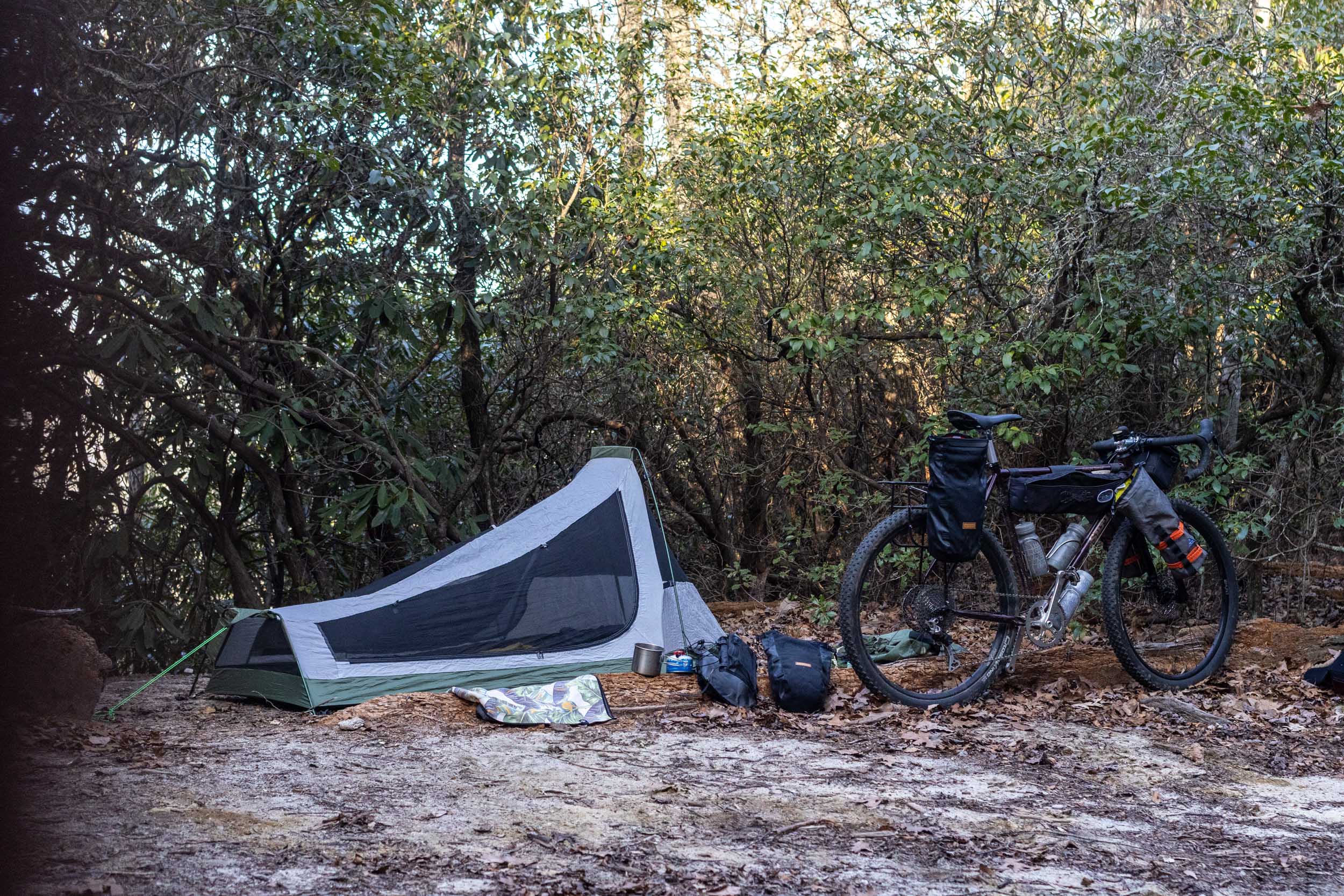
At a refreshing $150, some might imagine this solo tent too good to be true. After all, it’s packable, spacious, and even comes with a rainfly. In my long-term review, I compile nearly six years’ worth of experience with the tent to see how it’s held up across numerous trips.
Humble Beginings
My first bikepacking trip was a disaster. Fresh off a breakup, I set off with a local overnighter group on a typically Floridian December eve. It was 78 degrees just a few days after Christmas, and I’d borrowed all the gear I brought. Carrying a hammock, a quilt, and an airport pillow, I was intent on having a good night out under the stars.
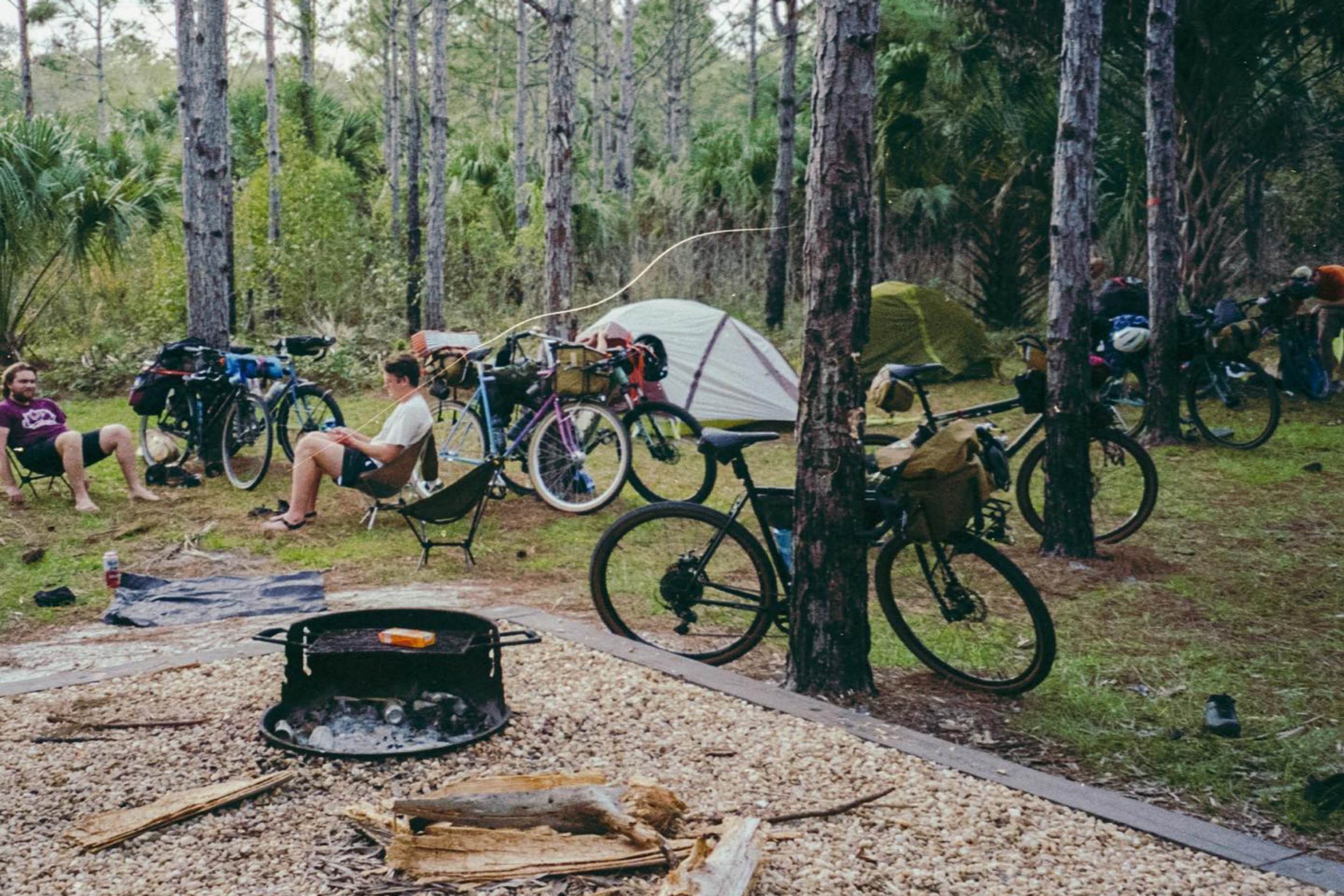
Though the overall experience left me with a feeling I still chase to this day, the physical sensations that resulted from that night weren’t as romantic. Because it was still so hot, the bugs—seemingly ever-present in the country’s biggest swamp—were in full force. With my skin exposed, mosquitoes quietly sucked my face dry that night, leaving me with a bulging, irritated skull the next morning. I’d managed a mere two hours of sleep, and I felt like shit.
Despite that, I had fun and wanted to do it all again. As I recounted the experience to friends and family over the coming weeks, I thought about what those around me were using for shelter. Some had two-person tents, some had tiny bivies, and some suffered, as I did, in slightly more upscale hammocks. Broke as I’d ever been, I took to eBay and searched “bivy.” I didn’t really know what I was looking for, but much like NSFW internet content, I knew it when I saw it. The GeerTop Blazer 1 Person 3 Season Ultralight Professional Bivy Tent was a sight for sore eyes. At $99.99, it was all I could afford, and it seemed like it would work. Nearly seven years have passed since that faithful day, and I still have the GeerTop in my possession. I’ve used it on most of the bikepacking trips I’ve been on, and it’s served me exceedingly well.
Specs and Setup
The GeerTop Blazer is made of 210T ripstop polyester with tape-sealed, double-stitched seams. The tent also comes with a rainfly made of the same material. The whole system felt cheap when I first got it, and I didn’t expect it to last long, but after years of use, it has no holes, abrasions, wear spots, or other material issues. The rainfly features a waterproof rating of 2500mm PU. Although I’ve avoided extreme downpours while using it, the rainfly has always come in handy during overnight showers and has never leaked. Using the rainfly leads to excess moisture buildup during shoulder seasons, but the main reason I’ve used the extra layer is to keep the heat in when temperatures drop. It makes a significant difference.
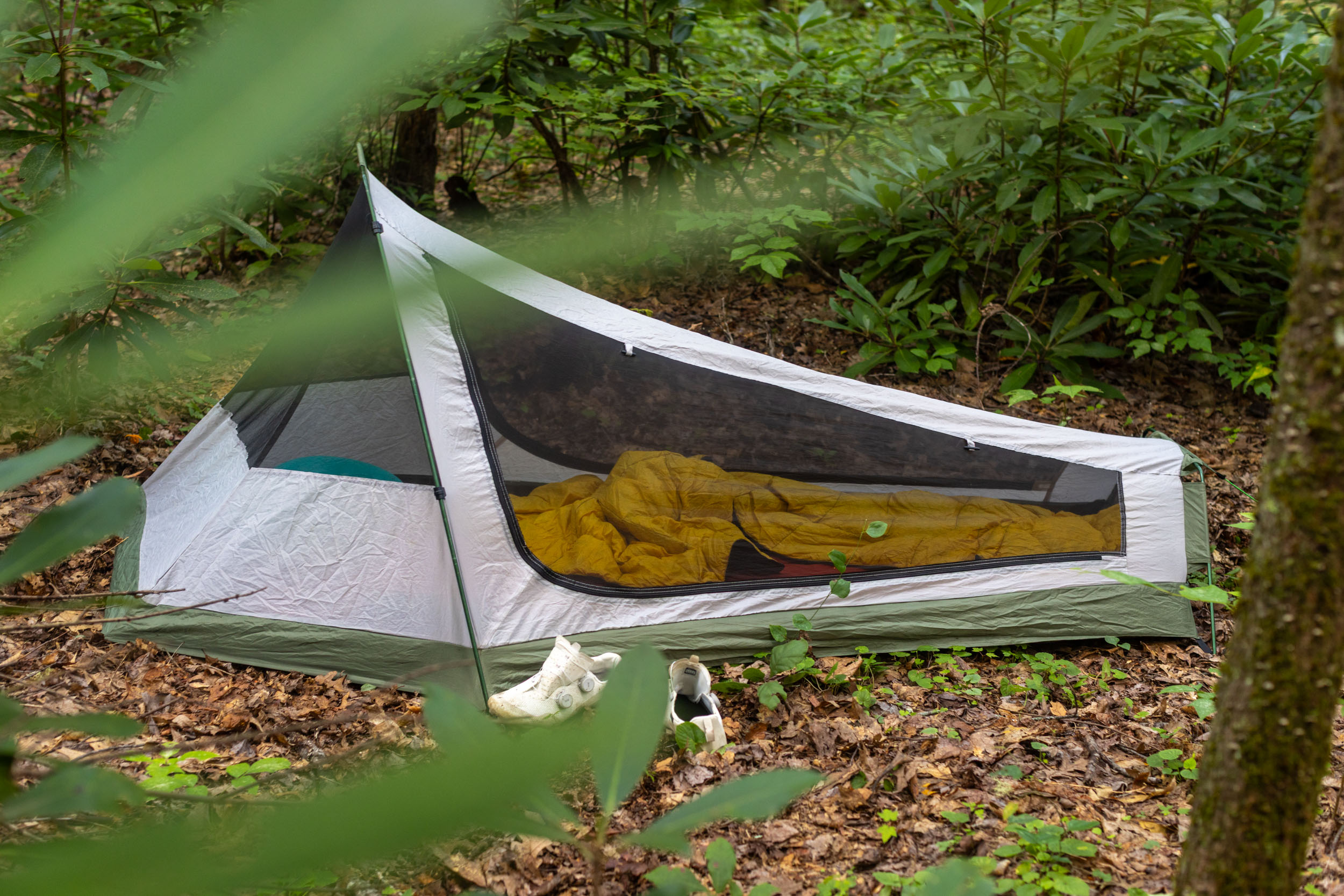
The tent’s body is one large piece staked to the ground at six points. Five are secured using the hooks on the aluminum stakes to tension the rings at the points directly attached to the body, while the foot of the tent is held up by a tension point and a small cord that sits about a foot away from the body. The tent has two mesh doors that run the length of the tent on either side, each with a double zipper. The tent gets its shape from two sets of internally bungeed aluminum poles that slide through sectioned sheaths at either end of the system. The pole ends attach to the same rings the stakes use, via a metal key-shaped piece at each end. The foot area is much shorter than the head of the tent, with the peak of the head area measuring just over three feet. The living space measures 84″ long x 39″ wide x 36″ high.
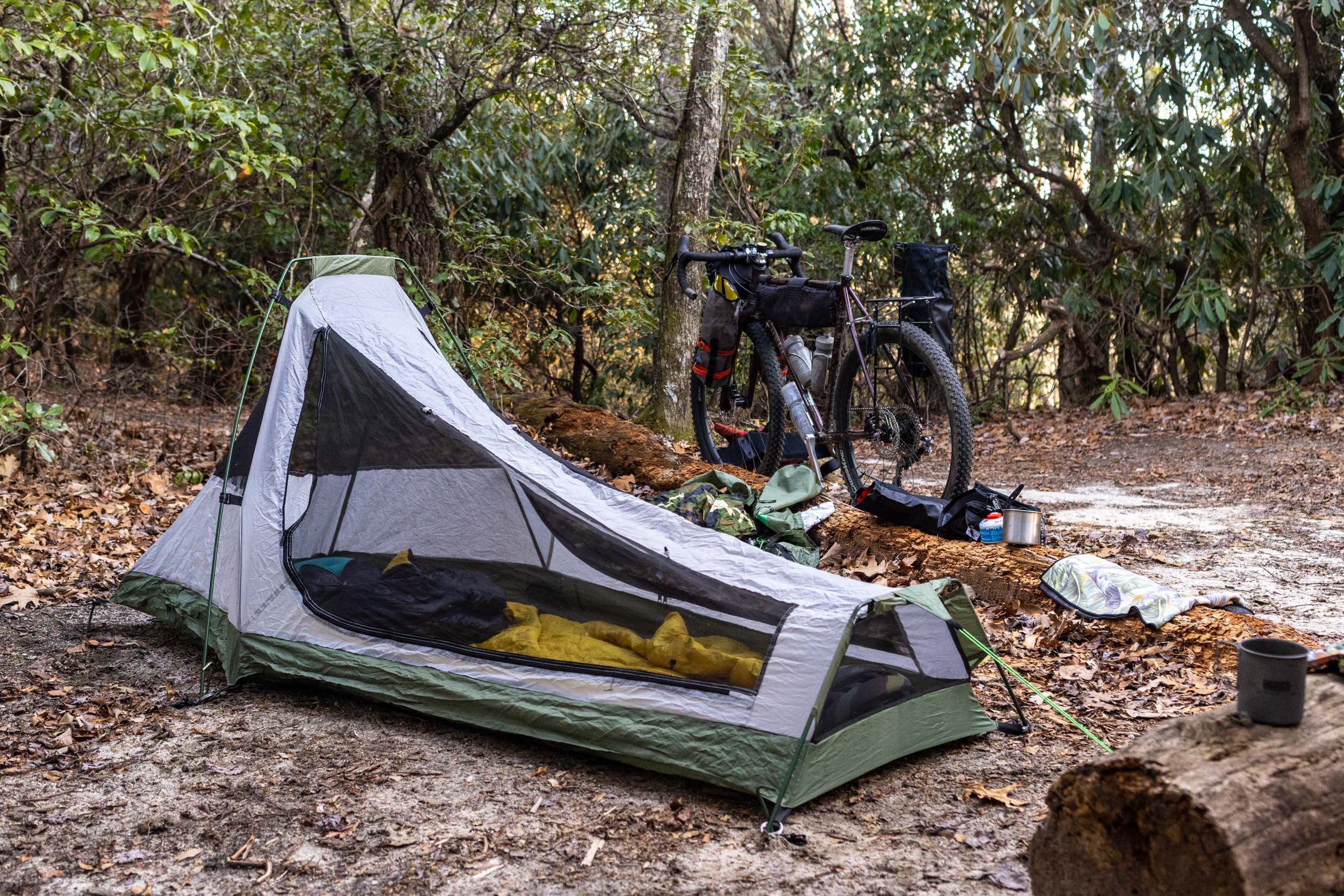
The tent is easy to set up, and I usually opt to stake the five rings into the ground before setting up the poles. On average, setup takes under five minutes, with the hardest part being attaching the poles to the key-shaped pieces at the rings. If the ground is too soft, the stakes can come out while you’re trying to slide the poles onto the end pieces. But it’s easy once you get the hang of the system.
Once the tent is appropriately tensioned and staked, attaching (and detaching) the rainfly is simple. Using the buckles, it connects to the main body and requires one extra point of tension at the head, increasing the tent’s footprint by about 12 inches. At the very end of the main body, there’s a small area that’s shielded by the rainfly, but it isn’t part of the tent’s interior. You access it with two zippers and can use it to store items like shoes or a helmet. Internally, the tent is barebones. It has a small plastic loop at the apex for a light or other small item, plus an internal pocket. I have never used the latter, but the loop is nice for reading or organization once inside.
Use and Function
The main reason I was drawn to the GeerTop was for the added headroom. Most, if not all, of the bikepacking trips I went on in my first two years were with groups. With limited spots to change and the constant presence of mosquitoes and other hungry bugs, I wanted a private space to change and sit up in. The main living space is sufficient in that respect, but it isn’t incredibly roomy. It offers just enough room to change clothes, but jackets and other outer layers are challenging because horizontal space is limited. Because of the its length, getting into a fresh pair of shorts or pants is easy, and I’ve always found the leg room sufficient. I can even slide up and down and adjust my position without feeling claustrophobic. I’ve used a variety of sleeping pads over the years, and the one I’m currently using, the 25” x 78” Big Agnes Rapide SL, fits well.
The best feature is the mesh doors. They provide great ventilation and are ideal for camping and bikepacking in the American Southeast. Bugs stay out, and you can even get a good view of the night sky, but the overall design provides ample protection from the elements. The bathtub floor rises roughly two inches above the walls. It’s the same ripstop material the rest of the tent uses, and as such is quite thin. It’s not great for insulation, but I’ve never needed a groundsheet. It’s been durable enough to handle trips through Oklahoma, Florida, North Carolina, Colorado, and Georgia, across a variety of surfaces.
Tough surfaces, however, are the tent’s main downfall. Because it isn’t a free-standing design, the system’s staked tension is where the GeerTop Blazer falters. I’ve been able to get by with creative solutions at a variety of campsites, but if you’re unfortunate enough to happen upon an area where the ground is impenetrable, it’s very difficult to set the GeerTop up. Moreover, the stakes are cheaply made and have bent over the years when I’ve hit a root or rock just beneath the soil. Perhaps it’s a lot to ask of a $150 tent, but this is undoubtedly the biggest issue.
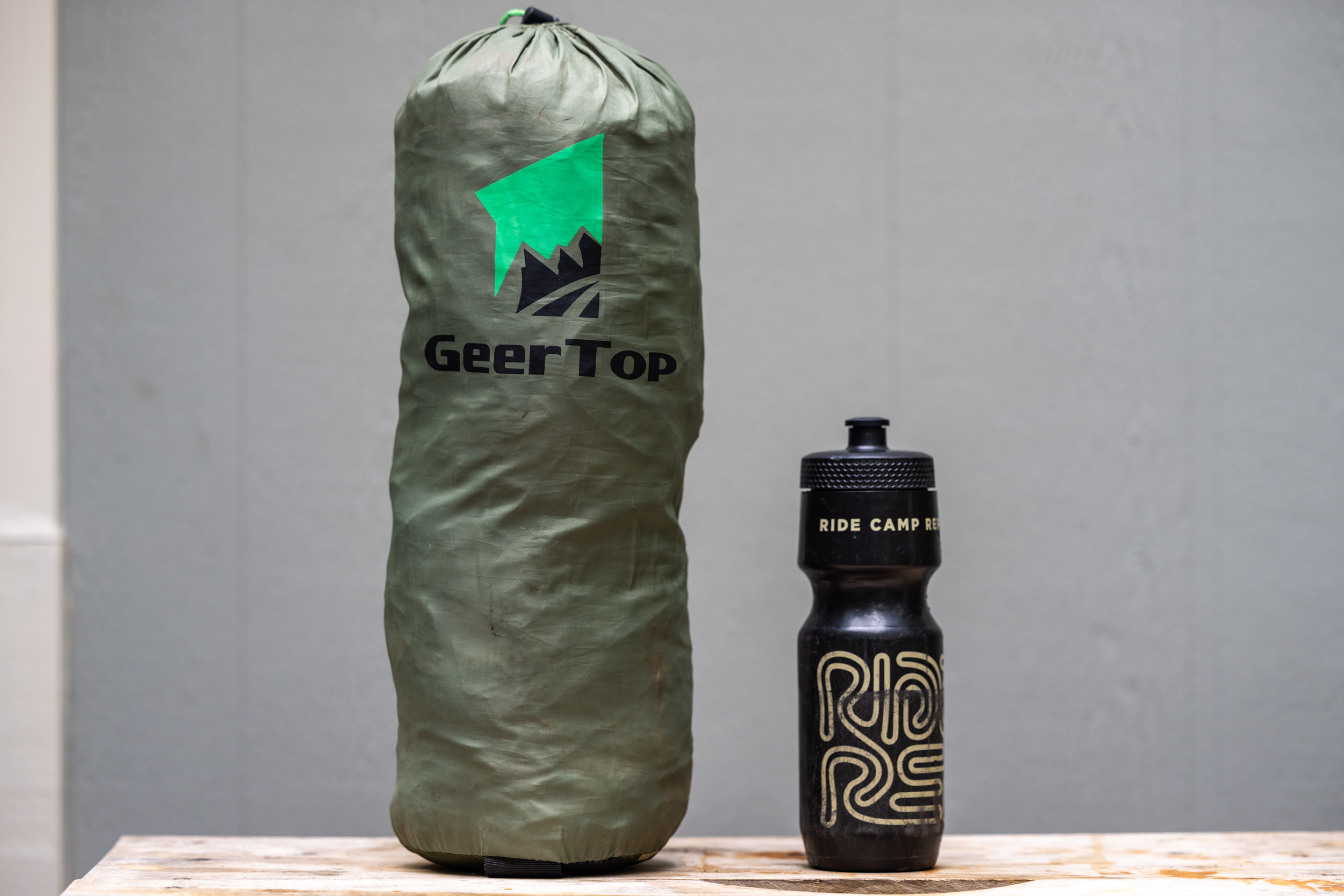
Those flaws aside, the system packs down nicely. Though I no longer use the included stuff sack, as it packs down much smaller in my fork and saddle bags, including a small bag for each part of the system is nice for organization. I’ve lost a few of the stakes, as the bag for both the poles and stakes is cheap and has a strange tie closure that never quite works, but it’s a relatively minor qualm. The only other annoyance is the lack of packability for the poles. They’re 18” long, even when collapsed to their smallest size. They fit okay in my large Outer Shell half frame bag, but the awkward, long, and rigid nature of these poles has often required some pack Tetris.
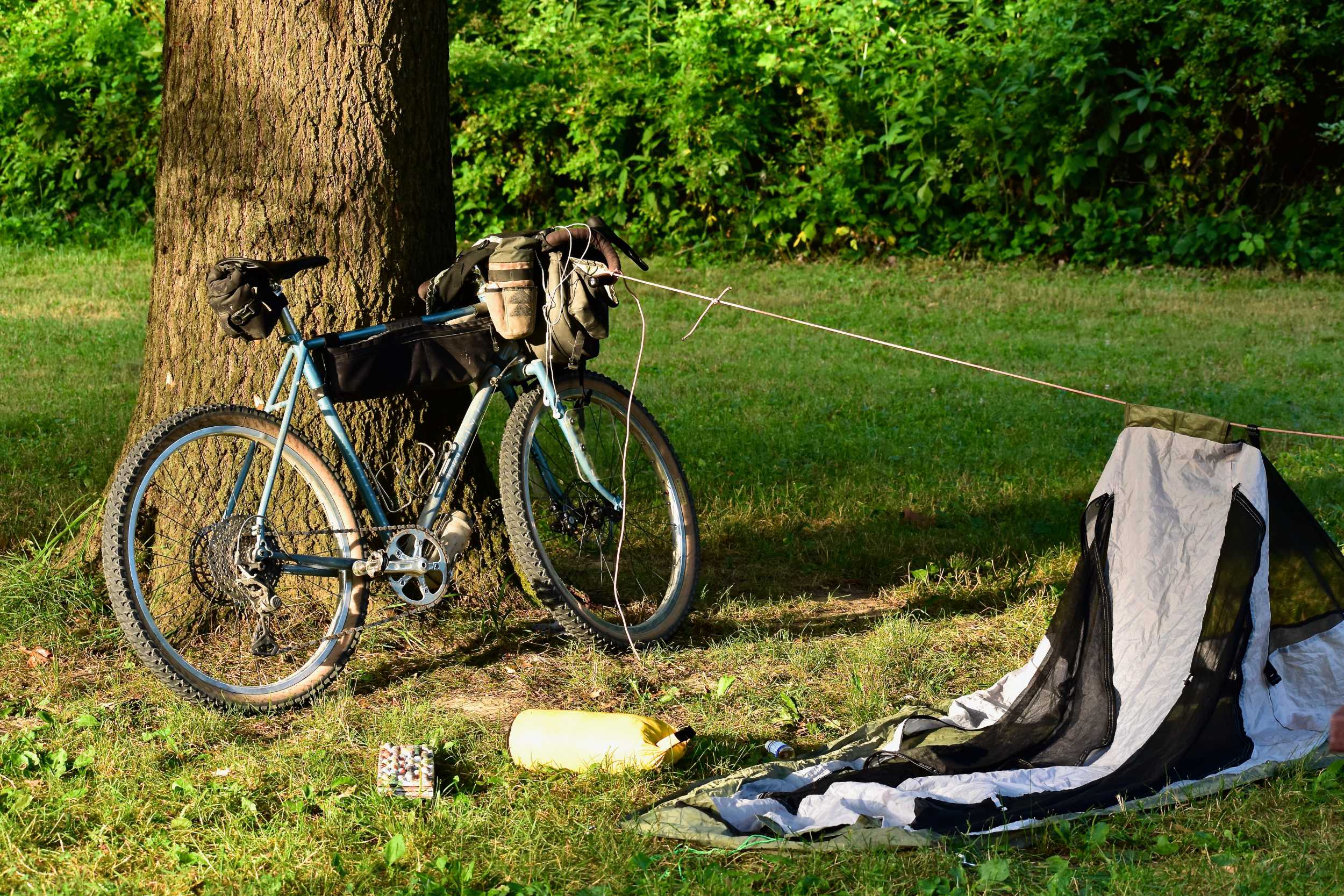
Forgetting my poles at home led to this less-than-ideal pitch on a bikepacking trip from DC to Pittsburgh. I ran some paracord through the pole sheaths and tied it to a bench to save myself from being eaten alive by West Virginia’s mosquitoes.
Overall, the tent has met needs I didn’t even realize I had. Since I started using the GeerTop Blazer, I’ve never once lamented the money I spent on the shelter and have always been amazed by its ease of use, weight, modularity, and performance compared with much more expensive systems. While some of my taller friends have popped in and found it too cramped, I’m slightly above average height for a man on this side of the globe and have never needed more length. The GeerTop has been a consistent, dependable option on almost every trip, and I will keep using it until it dies.
- Model Tested: GeerTop Blazer, Green
- Actual Weight: 1.2 kilograms (2.7 pounds)
- Place of Manufacture: China
- Price: $150
- Manufacturer’s Details: GeerTop
Pros
- Incredibly affordable
- Mesh doors provide great ventilation
- Generous headroom
- Easy to setup
- Rainfly works to keep heat in and the elements out
Cons
- Cheaper materials
- Moisture build-up is significant with or without the rain fly
- Stakes are cheap and bend easily
- Tricky to set up on tough, rocky ground
Wrap Up
Although the price has increased by $50 since I bought the tent, I would still consider the GeerTop Blazer the best budget bikepacking tent I’ve ever come across. I feel extraordinarily lucky to have fallen ass-backward into one of the best options for my first shelter, as it sets a high standard for what I consider “worth it.” Despite its cheaper materials, its design and construction have held up on numerous trips in all kinds of conditions. Its spacious headroom, great ventilation, modular rainfly, and seemingly unkillable ripstop construction make it a standout for a budget single-person tent. At the lower end of the market, it’s a true wonder it’s still going strong long after I expected a fatal issue to arise.
Further Reading
Make sure to dig into these related articles for more info...
Please keep the conversation civil, constructive, and inclusive, or your comment will be removed.











 English (US) ·
  French (CA) ·