

 1 day ago
4
1 day ago
4
PROTECT YOUR DNA WITH QUANTUM TECHNOLOGY
Orgo-Life the new way to the future Advertising by AdpathwayThink of this seated pose as your stretching Swiss-army knife.
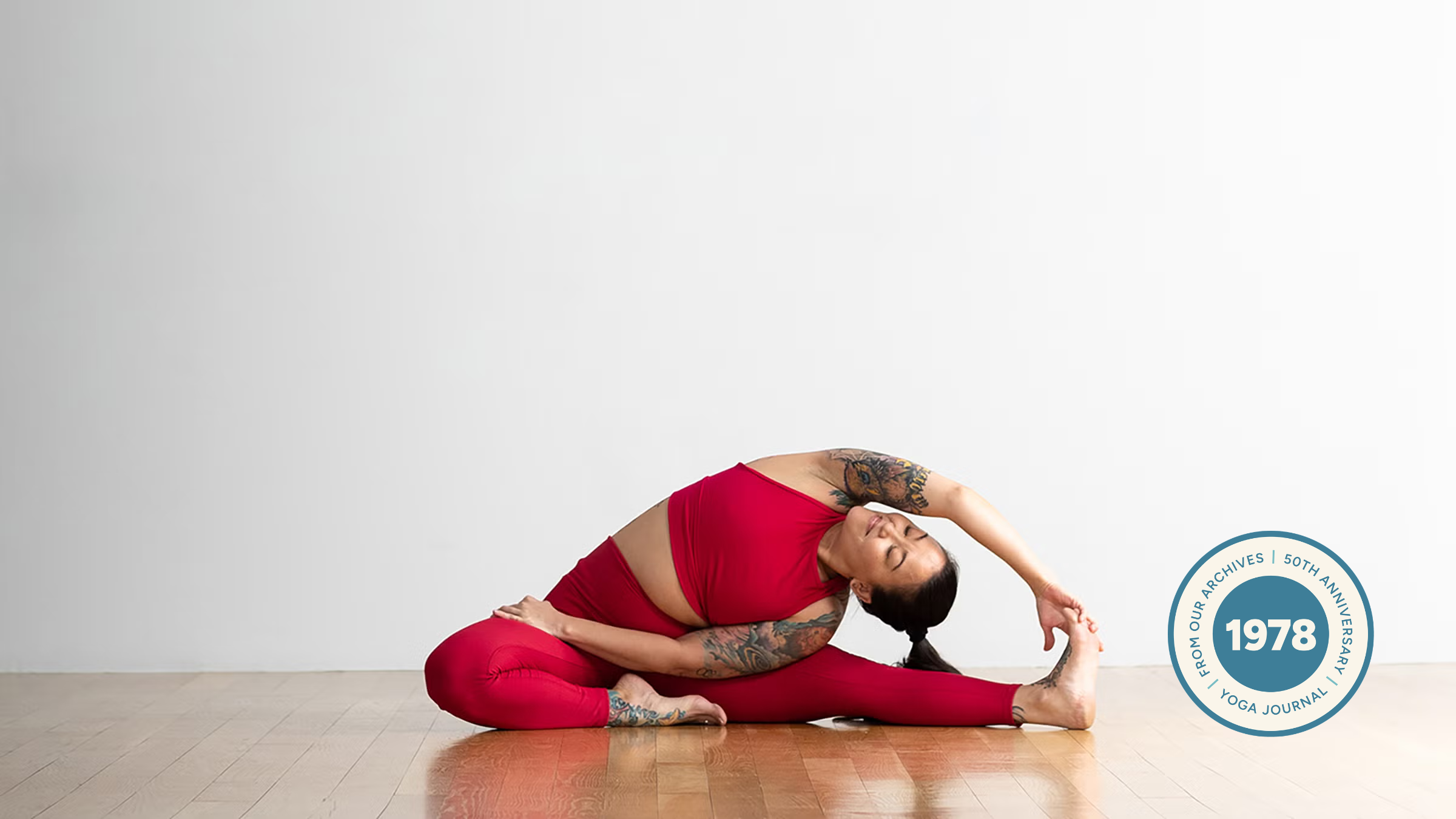
(Photo: Andrew Clark)
Published August 26, 2026 11:35AM
In Yoga Journal’s Archives series, we share a curated collection of articles originally published in past issues beginning in 1975. These stories offer a glimpse into how yoga was interpreted, written about, and practiced throughout the years. This article about Revolved Head-to-Knee Pose first appeared in the January-February 1978 issue of Yoga Journal. Find more of our Archives here.
Revolved Head-to-Knee Pose (Parivritta Janu Shirsasana) is one of the most beautiful and difficult poses of the sitting series. It combines the surrender of a forward bend and the grace of a seated twist. Before attempting the twisting variation, the student should have an understanding of the simpler Head-to-Knee Pose (Janu Sirsasana). This is the forward bend done with one knee bent, the heel drawn up toward the root of the opposite thigh, and the chest moving toward the straight knee. In Revolved Head-to-Knee Posethe head does not stop at the knee, but moves down the shin as the student rotates the torso. The name itself means “revolved head and knee pose.”
Forward bends are attempts by the yogi or yogini to express the concept of surrender. In Revolved Head-to-Knee the body must first surrender to a forward bend as if making the obeisance of prayer. Then the prayer is offered towards the heavens as the student’s body revolves. This places the heart region-area of love and sharing-facing upwards, symbolizing the search for higher consciousness.
Physiologically and anatomically, the pose can accomplish many things. B.K.S. Iyengar in Light on Yoga cites especial benefits for the abdominal organs; they are actively massaged as the torso rotates. The stretch comes mainly from the hamstring muscles in the back of the thigh. The backs of the knees are also worked as are the calves.
One of the most invigorated areas in the pose is the back, especially the back of the waist, along the latisimus dorsi muscle. This muscle runs from the pelvic brim in the back, up all the lumbar vertebrae and the last six thoracic vertebrae. It inserts in the underarm area. Thus, the latisimus is used in this pose as the arms pull the body forward toward the foot. The fascia, or connective tissue, which lies over the lower back and waist area, is stretched more than in most poses. This can be felt as distinct from muscle stretch which the student would be feeling in the hamstrings. This is an important point. The philosophy of Hatha Yoga stresses the importance of awareness of the body in space as prerequisite to meditation. This pose offers awareness to the student in terms of quality of sensation. There is the deep stretch of the muscles, the more superficial but biting stretch of the connective tissue, and the strength required in the arms to pull the body forward.
Another important area to consider in this pose, is the vertebral column. It is in a flexed as well as rotated position. This is a potentially dangerous position if the movement is done suddenly or without due consideration for the adaption necessary for the spine. This is because the small facet joints of the column are not evenly gapped, and are therefore not in a stable or “close packed” position.
To prevent injury to the column, I recommend that the student practice the pose by twisting first and then bending forward. Coming out of the pose is equally important. The student should first unrotate the spine and then sit up. The correct breathing procedure is to inhale as you twist, exhale as you bend forward and inhale as you sit up.
Yoga philosophy also teaches that all our miseries stem from our lack of knowledge about our true Self. We are caught up in prakriti, matter or the manifested universe, and do not experience the essence of our true spirit, or purusha. Through the practice of asanas, the student learns endurance while holding the poses in the midst of discomfort. It is by becoming aware of our discomfort at the self-imposed feeling of separation between prakriti and purusha within us, that the faculty of buddhi, or subtle intelligence, can let go its attachment to prakriti and allow purusha to manifest.
Unless one is able to experience discomfort, one will never know the separation of purusha and prakriti which has been created by buddhi. This is true because buddhi can hide discomfort in the rush for physical and mental comfort that one seeks through sense gratification. Yoga, therefore, does not create discomfort, which already exists because the soul is seemingly unaware of its oneness with purusha.
In addition, by experiencing discomfort in the pose, and yet remaining in a tranquil state, the dvandvas will not be so overpowering. (The dvandvas are the opposite conditions of pleasure and pain.) Students can then learn how to remain equally conscious in whatever outer states they find themselves, especially outside class. Thus by observing themselves and their reaction to success or failure in the asana, the students can begin to consciously experience the fluctuating nature of the dualities of pain and pleasure. It is the attachment to these dualities which prevent the union of the lower and higher selves. Thus asana becomes a valid tool for exploring consciousness and meditation.










 English (US) ·
  French (CA) ·